Saturday, October 2, 2021

“The Great Reset” Is the Road to Socialism Mises Warned Us About

by Tho Bishop, Mises Institute: Through the sheer power of his intellectual output, Ludwig von Mises established himself as one of the most important intellectuals of the twentieth century. His work Human Action remains a foundational text of the Austrian school. His critique outlining the impracticality of socialism was vindicated with the fall of the Soviet Union […]
http://dlvr.it/S8nx59

France Begins "Price Protection" Measures To Shield Consumers From Soaring Energy Prices

France Begins "Price Protection" Measures To Shield Consumers From Soaring Energy Prices French Prime Minister Jean Castex announced several "price protection" measures to counter rising natural gas and electricity prices to thwart discontent ahead of the presidential election, according to FT.  "We're going to introduce what I would call a tariff shield for gas and electricity," Castex said during a televised speech on Thursday evening. "We are going to protect ourselves from these price increases." He said any new natgas tariffs following Friday's scheduled 12.6% hike would be postponed until prices decrease in late March/April, adding that it will shield 5 million households who are on floating-rate contracts. Castex said the French government would lower taxes on power prices, capping the scheduled increase in residential electricity tariffs at 4% in February. With natural natgas and electricity prices poised to keep climbing as cooler weather is just ahead, France's energy policy has a social element to it to thwart social discontent for President Emmanuel Macron until after the election.  "No further price rises after October 1 until a drop in global prices, expected in March or April," Castex said.  French consumers have been somewhat protected from soaring energy prices affecting much of Europe and Asia because 70% of the country's power is sourced from nuclear plants. Nonetheless, there's a segment of the country that relies on fossil fuel generation.   Regarding the tariff cap, Castex said natgas suppliers would be compensated for any losses. He said commodity experts believe natgas prices to "strongly" decline by spring. At the moment, European natgas prices are through the roof as supplies remain tight. Dutch natgas futures surged to 100 euros Friday as Russian natgas flows into Europe collapsed.  For French President Emmanuel Macron, the European energy crisis couldn't have come at the worst time as the presidential election is slated for April. The president doesn't need any more social unrest as protesters weekly have been seen marching on the streets, demonstrating against COVID restrictions and vaccine passports.  So the energy policy in play is to mitigate rising power costs to keep Macron in power. How long until the government starts compensating people for meals as food prices hover around decade highs? Tyler Durden Sat, 10/02/2021 - 09:55
http://dlvr.it/S8nSfw

Friday, October 1, 2021

John Paulson Takes New Instagram Fitness Guru Girlfriend On Post-Divorce Getaway

John Paulson Takes New Instagram Fitness Guru Girlfriend On Post-Divorce Getaway Billionaire hedge fund titan John Paulson isn't wasting any time after divorcing his wife of nearly two decades. Page Six reports that Paulson, who won fame for his billion-dollar take from his bets against mortgage-backed securities ahead of the collapse of the US housing market. escorted his much-younger girlfriend, Alina de Almeida, 33 (vs. Paulson's brisk 65), to the shores of Lake Como for a romantic getaway weekend. Witnesses told the NY Post's gossip page that the couple was traveling to attend the wedding of Blackstone executive Mark Mofatt and British beauty Sarah Mintz at romantic 16th-century Villa d’Este on Sept. 25. The paper's sources said the pair "canoodled all day and night" and that "he and Alina were inseparable." Page Six was first to report Paulson's divorce from his wife, Jenny Paulson, which could see the division of a billion-dollar fortune since the pair reportedly don't have a prenup. Paulson's new girlfriend is an Instagram diet guru. Sources say they met via "mutual friends" this summer. Sources say she has moved into his Fifth Avenue Apartment. De Almeida runs Effective Lifestyle, which features shots of De Almeida's toned body in skimpy workout gear. One source told the Post: "John does have a new, much younger girlfriend and while it is still early days, the relationship is blossoming. They are very happy." With a billion-dollar fortune at stake, De Almeida may be remembered as one of America's greatest homewreckers (Paulson and his wife have two children together). Rumor has it Paulson was so bold as to invite his new squeeze to the same gala dinner where he was honored, even seating her near Paulson and his wife. At least he was respectful enough to follow the old custom: wives in the front, girlfriends in the back. Tyler Durden Fri, 10/01/2021 - 15:18
http://dlvr.it/S8lQy6

The Debt Ceiling Non-Crisis & Why Rates Will Fall

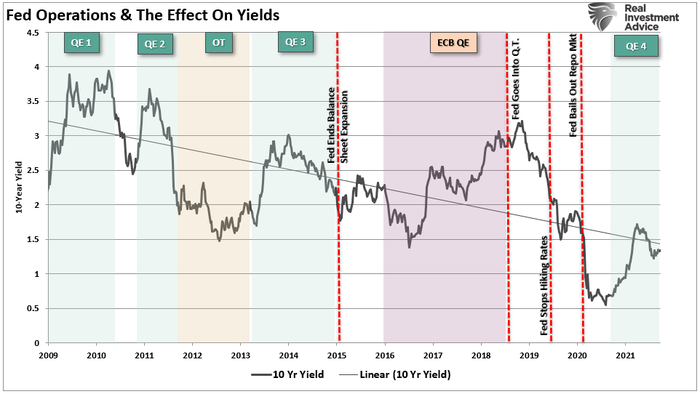
The Debt Ceiling Non-Crisis & Why Rates Will Fall Authored by Lance Roberts via RealInvestmentAdvice.com, The financial media is rife with misinformation on the debt ceiling and the jump in interest rates. However, a review of history shows that not only is the “debt-ceiling” issue a non-crisis, but the recent rise in rates is likely an opportunity to buy bonds. Let’s start with the media scare tactics over the debt ceiling: * If Congress doesn’t raise the debt ceiling, the Treasury will run out of money. * The U.S. will default on its debt. * The markets and economy will crash. While there is a grain of truth behind these statements, they are largely false. However, for the media, a manufactured crisis should never be allowed to go to waste. To wit: “As Washington teeters closer to a possible government shutdown at midnight Thursday, here’s why the status of the nation’s debt ceiling may ignite more worry in financial markets. Sept. 30 marks the end of the federal government’s fiscal year, and the deadline for Congress to pass a funding measure. The debt ceiling, which is the amount of money lawmakers authorize the Treasury Department to borrow, must be suspended or raised by Oct. 18, according to Treasury Secretary Janet Yellen, or the U.S. likely will default on its debt.“ – MarketWatch CBS took the “fear-mongering” to a whole new level with this statement: “The U.S. economy could plunge into another recession this fall if Congress fails to lift the debt ceiling and the nation is unable to pay its obligations, according to an analysis by Moody’s Analytics chief economist Mark Zandi. The fallout would wipe out as many as 6 million jobs and erase $15 trillion in household wealth, he estimated in a report.” While a remarkable statement to get “clicks,” even a cursory review of history suggests the hyperbole falls well short of reality. Both Parties Equally Responsible For Lifting The Debt Ceiling Let’s start with an explanation of the “debt ceiling.” “The debt ceiling is the legal limit on the total amount of federal debt the government can accrue. The limit applies to almost all federal debt, including the roughly $22.3 trillion of debt held by the public and the roughly $6.2 trillion the government owes itself as a result of borrowing from various government accounts, like the Social Security and Medicare trust funds. As a result, the debt continues to rise due to both annual budget deficits financed by borrowing from the public and from trust fund surpluses, which are invested in Treasury bills with the promise to be repaid later with interest.” – CRFB The entire purpose for establishing a debt ceiling was to place a “credit limit” on the Government. In a responsible Government, as the debt ceiling approaches, members of Congress should begin discussing budget cuts, spending reductions, or revenue increases. The goal, logically, is to keep the country in a “surplus” position over time. In 1980, that all changed, and seven administrations and four decades later, Government debt surged, deficits exploded, and the debt ceiling rose 78 times. (49 times under Republicans and 29 times under Democrats.) Has The U.S. Ever Defaulted On Its Debt? “Investors in T-bills maturing April 26, 1979, got told that the U.S. Treasury could not make its payments on maturing securities to individual investors. The Treasury was also late in redeeming T-bills which become due on May 3 and May 10, 1979. The Treasury blamed this delay on the failure of Congress to act in a timely fashion on the debt ceiling legislation in April. Also, an unanticipated failure of word processing equipment used to prepare check schedules contributed to the delay.” – The Financial Review What the mainstream media missed, because “fear-mongering” attracts readers, is there are two types of default. The first is an actual default where the borrower cannot pay its debts due to a lack of capital. The second is a “technical default.” In 1979, as noted, the Treasury was hung up over a “debt ceiling debate” and could not make interest payments. There was little worry by lenders over the safety or security of their capital. They knew that when the U.S. resolved the “technical issues,” the Government would make its payments. Such is the “crisis” bond investors currently face. * Could there be a short-term delay in making interest payments? Absolutely. * Is there any risk of a default on the payment of interest or principal on outstanding Treasury bonds? Absolutely not. As shown, 10-year rates did spike shortly over the initial concerns of the default. However, as soon as bondholders realized there was no continuing threat, they began to buy bonds at a discount to the previous value. Over the next couple of months, rates fell as sanity returned to the bond market. (Later that year, rates would rise again over legitimate concerns of the oil crisis.) The Democrats Have All The Power To Solve The Problem Despite all of the media narrative we noted previously; the Democrats did not need ANY Republican votes to: * LIft the debt ceiling * Fund the Government via “Continuing Resolution,” or “C.R.” * Pass the $3.5 Trillion spending bill. The Democrats did what we expected on Thursday and passed a “clean Continuing Resolution” to fund the government until December 3rd. U.S. House, in 254-175 vote, OKed the Senate-passed continuing resolution ("CR") to extend government funding to Dec. 3 and avert a partial shutdown. Also includes billions for disaster aid and Afghan evacuation & resettlement. Biden's signature next. D 220-0, R 34-175 — Greg Giroux (@greggiroux) September 30, 2021 The problem for the Democrats in separating the Continuing Resolution from the debt ceiling is they lost any leverage to force a bipartisan debt vote to suspend the debt limit. Such puts the Democrats in a precarious position. With no bipartisan support, the Democrats will own the entirety of the debt increases in the upcoming mid-term elections. Such could be very problematic for representatives from more moderate “purple” states like Virginia and Georgia. As a result, even progressive Democrats are pushing back on Biden and Pelosi’s “runaway” spending plans. As noted above, it is not surprising to see Treasury yields rising once again. However, the current rate of change in rates is not historically dramatic and well within the context of what one would expect. Debt Ceiling Crisis Redux As Congress lifts the debt ceiling for the 79th time, the runaway spending and deficit increases continue to accelerate. The consequence of increasing debts and deficits is evident in the declining economic growth rates over the past 40-years. During the last 12-years, a debt ceiling fight is an annual event between policymakers. The most prominent of which was in 2011 that led to a comprise to cut $1 trillion in spending. At that time, Ben Bernake launched the third round of Quantitative Easing to compensate for what was feared to be a “fiscal cliff” in 2013. Such was due to spending cuts getting automatically imposed. As shown, rates spiked during the “debt ceiling crisis” as concerns over default rose. Subsequently, rates fell to new lows as deficits surged and economic growth slowed. Rates initially jumped over concerns of spending cuts, but the massive amount of QE injected into the system fueled stocks into overdrive, and yields collapsed. Why Now Is Likely A Great Bond Buying Opportunity There are several vital points evident from reviewing history. * While politicians talk a tough game, the current debate over the debt ceiling is nothing more than political posturing. * The media is a primary source of misinformation over the debt ceiling and potential outcomes. * Bond investors should be welcoming the debt ceiling debate as an opportunity to buy bonds at cheaper prices with higher yields. Are there currently risks to the bond market that investors should be concerned about near term? Yes. The current spike in inflation will likely last longer than expected due to the break of supply lines. Furthermore, rates tend to rise when the Fed begins to discuss “tapering” their bond purchases as they are doing now. However, both of these issues will resolve themselves going forward. Eventually, the supply chain disruption will mend, and inflation will decline as supply comes back online. More importantly, when the Fed does begin the process of “tapering” their bond purchases, yields historically fall as investor’s “risk-preference” shifts from “risk-on” to “risk-off.” As if always the case with investing, timing, as they say, is everything. Such is why, with interest rates at more extreme overbought levels, we are looking for our next opportunity to add duration to our bond portfolios. Moreover, with the equity market grossly overvalued, we suspect that bonds will provide a chunk of our capital gains over the next couple of years. There is little upside to the equity market. However, when the next recession approaches, yields will once again likely approach zero. Got bonds? Tyler Durden Fri, 10/01/2021 - 15:00
http://dlvr.it/S8lNVD

Weekly Update — ​The Biggest Federal Reserve Scandal

from RonPaulLibertyReport: TRUTH LIVES on at https://sgtreport.tv/
http://dlvr.it/S8lC6d

White House Economic Adviser Admits Higher Inflation Likely To Stick Around Longer

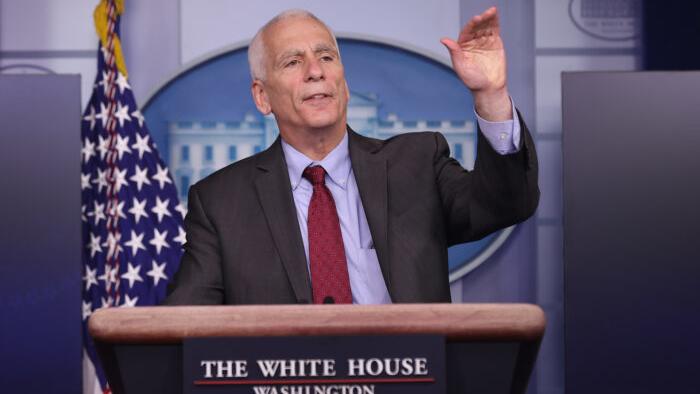
White House Economic Adviser Admits Higher Inflation Likely To Stick Around Longer Authored by Tom Ozimek via The Epoch Times, White House economic adviser Jared Bernstein told Fox News in a recent interview that inflation is likely to stay elevated longer than previously expected. Bernstein told the outlet that he thinks the rate of inflation will come in at around 4 percent for 2021, before falling to 2.3 percent in 2022. He did not say when, precisely, he expects the rate will tick down next year, but noted inflation would likely stay high into the middle of next year. His expectations closely track the Fed’s most recent predictions. While Bernstein did not specify which inflation measure he was referring to, his estimates are in line with the most recent Personal Consumption Expenditure (PCE) inflation projections from the Federal Open Market Committee (FOMC), the Fed’s policy-setting body. After its most recent Sept. 21–22 meeting, the FOMC issued a revised set of economic projections (pdf) that estimate the PCE inflation rate at 4.2 percent for 2021, a sharp upward revision from June’s projection of 3.4 percent. For 2022, Fed policymakers expect PCE inflation of 2.2 percent, up from an earlier projection of 2.1 percent. However, the 18 members of the FOMC varied in their predictions, ranging in next year’s PCE inflation estimate from 1.7 percent to 3.0 percent. Bernstein, like Fed officials and many economists, blame supply-side disruptions for the bulk of the recent inflationary spike. When supply chain dislocations get ironed out, inflation will subside, he argued. Some economists have warned of the growing risk of stagflation—where economic growth falls while inflation stays high. Economist Nouriel Roubini, known for his gloomy-yet-accurate forecast of the 2008 financial crash—a prediction he made at a time of peak market exuberance—warned in a recent op-ed that the global supply chain crisis, combined with high debt ratios and ultra-loose monetary and fiscal policies, threatens to turn the “mild stagflation” of recent months into a full-blown stagflationary crisis. Stephen Roach, former Morgan Stanley Asia chairman, on Wednesday became the latest high-profile economist to sound the alarm on the risk of the United States facing 1970s-style stagflation. Roach thinks the energy price spike is inflicting major damage to struggling supply chains, pushing up the risk of higher price growth even if the economy slows down. While Fed officials maintain that the current bout of inflation is temporary and will abate once supply chain dislocations ease, they’ve acknowledged that inflation has been higher and longer-lasting than they previously believed. New York Federal Reserve Bank President John Williams said on Sept. 27 that consumer expectations for what the rate of inflation will be several years down the road remain “well-anchored” at around the Fed’s 2 percent objective, though he said there are upside risks and a “great deal of uncertainty” around the inflationary outlook. Tyler Durden Fri, 10/01/2021 - 13:40
http://dlvr.it/S8l8k0

European Gas Hits A Record 100 Euros As Russian Gas Flows Collapse By 77%

European Gas Hits A Record 100 Euros As Russian Gas Flows Collapse By 77% While Russia would never admit it, Putin is slowly but surely tightening the screws on Europe's hyperinflating energy prices just as China told the world it will buy every source of energy that is not nailed down. On Friday, front-month European nat gas (Dutch TTF) briefly soared to a record 100 euros before retreating, at the as China stepped up a global fight for energy supplies, ordering top energy companies to secure energy supplies "at all costs" in a move that threatens to push prices to unprecedented levels, and comes just as flows into Germany via a key Russian pipeline tumbled. Dutch gas futures surged to 100 euros a megawatt-hour, before retreating 0.7% to 97 euros. Prices were swinging between gains and losses as traders weighed the potential for demand curbs as more factories shut or reduce production. Europe has been scrambling to secure enough gas and coal ahead of the winter, with rising prices forcing some of industrial giants from fertilizer producers CF Industries to Yara International ASA and chemicals giant BASF SE to shut plants or curtail output. As Bloomberg energy commentator Javier Blas puts it, "European gas prices are (and had been for several weeks already) in full demand-destruction mode. The market is trying to force industrial consumption off to preserve gas for the rest of the (largely price inelastic) economy." Translation: millions of people will end up without heating during the winter. GAS MARKET: European gas prices are (and had been for several weeks already) in full demand-destruction mode. The market is trying to force industrial consumption off to preserve gas for the rest of the (largely price inelastic) economy | #EuropeanEnergyCrunch — Javier Blas (@JavierBlas) October 1, 2021 Unfortunately for Europe, no matter how high the price of gas, it's not as if someone can magically flip the switch and unleash supply. As it stands, European storage sites are just under 75% full, the lowest level for this time of year in more than a decade and are about to get even lower: inventory withdrawals typically start by the end of the month, depending on the weather. So far, temperatures in northwest Europe are forecast to be largely within seasonal norms in October. Meanwhile, reminding Europe once again who is in charge at least of winter heating, flows from Europe's top supplier Russia into Germany’s Mallnow via the key Yamal-Europe pipeline plunged by 77% from Thursday, just as the heating season begins. At an auction on Thursday, no extra pipeline capacity was booked to deliver fuel to the Mallnow compressor station the following day. Physical flows via the Yamal-Europe pipeline, which traverses Poland, have dropped to 5,313 megawatt hour per hour on Friday morning from 22,705 megawatt hour per hour on Thursday evening via the Mallnow entry point, according to the data. Supplies via the pipeline have oscillated over the past few weeks, but were largely on a declining track. Exports via the pipeline plunged in August after a fire at Gazprom facilities. Flows dropped as Gazprom has booked only about a third of the gas transit capacity it was offered for October via the Yamal-Europe pipeline and no extra transit capacity via Ukraine. Gazprom declined to comment. It has repeatedly said it was supplying customers with gas in full compliance with existing contracts and said additional supplies could be provided once the newly built Nord Stream 2 gas pipeline was launched. “Gas can go now as high as it needs to knock demand out,” said Andreas Gandolfo, leader of the European power team at BloombergNEF. “For some European industries gas has become too expensive. For some, including us, who have gas heating at home, it can probably go a lot higher before there is a decision to switch off.” According to Bloomberg, the treat of more industrial closures in Europe also risks stalling the rally in European carbon futures. Some of the companies curtailing production or closing factories are energy-intensive users and need to use carbon permits to cover their emissions. The slowdown could lead them to sell their allowances, said Trevor Sikorski, head of natural gas and energy transition at the London-based consultants Energy Aspects. To avoid popular unrest, governments are struggling to respond to the crunch, with an increasing number taking steps to try to shield voters from the worst effects of rising prices. France will block any new increase in regulated gas tariffs and cut taxes on electricity, Prime Minister Jean Castex said on TF1 on Thursday. “The volatile trading already shows that no one really knows how high gas can go, but we’re definitely in for a wild ride,” said Niek van Kouteren, a senior trader at PZEM, a Dutch energy company. “The question will be: where there will be demand destruction? If you then see governments stepping in and subsidizing gas prices, like France announced yesterday, there is no incentive at all to lower your demand.” Meanwhile, Europe's energy crisis has fully hit Asia, where the price of liquefied natural gas surged to a record $34.47 per mmBtus on Thursday. Both the cost in Asia and in Europe are about $190 a barrel of crude oil equivalent. Tyler Durden Fri, 10/01/2021 - 09:45
http://dlvr.it/S8kQcf