Saturday, October 10, 2020

Negative Returns Are Now In US Mortgages

Negative Returns Are Now In US Mortgages Tyler Durden Sat, 10/10/2020 - 12:25 Submitted by Chris Whalen of the Institutional Risk Analyst Watching the talking heads pondering the next move in US interest rates, we are often amazed at the domestic perspective that dominates these discussions. Just as the Federal Open Market Committee never speaks about foreign anything when discussing interest rate policy, so too most observers largely ignore the offshore markets. Yen, dollar and euro LIBOR spreads are shown below. Zoltan Pozsar, the influential money-market strategist at Credit Suisse (NYSE:CS), warns that the short-end of the US money markets are likely to be awash in cash over the end-of-year liquidity hump. Unlike the unpleasantness in 2018, for example, we may see instead a surfeit of lending as banks scramble for yield in a wasteland bereft of duration. Would that it were so. The Pozsar view does not exactly fit well with the rising rate, end of the world scenario popular in some corners of the financial media ghetto. The 10-year note is certainly rising and with it the 30-year mortgage rate. Indeed, Pozsar reminds CS clients that yen/$ swaps are now yielding well-above Treasury yields for seven years. Hmm. We believe short-term rates will remain low in the US, even as offshore demand for dollars soars. If the 10-year Treasury backs up much further, then we’d look for the FOMC to act on some calls by governors to buy longer duration securities. That is, a very direct and large scale increase in QE and particularly on the long end of the curve. We expect that Chairman Powell knows that underneath the comfortable blanket of low interest rates lie some truly appalling credit problems ahead for the global economy, the US banking sector and also for private debt and equity investors. We expect the low interest rate environment to drive volumes in corporate debt and residential mortgages, even as other sectors like ABS languish and commercial real estate gets well and truly crushed. “The pandemic is putting unprecedented stress on CMBS markets that even the Fed is having difficulty offsetting," writes Ralph Delguidice at Pavilion Global Markets. “Limited reserves are being exhausted even as rent collection and occupancy levels remain serious issues… Bondholders expecting cash are getting keys instead, and in our view, ratings downgrades and significant losses are now only a formality.” We noted several months ago that the resolution of the credit collapse in commercial mortgage backed securities or CMBS will be very different from when a bank owns the mortgage. As we discussed with one banker this week over breakfast in Midtown Manhattan, holding the mortgage and even some equity in a prime property allows for time to recover value. Delguidice rightly identifies that "extend and pretend" by consuming reserves is the first and, frankly, wrong strategy. The agencies have flagged this tendency since the summer, but now comes the reckoning. When the cash is exhausted, then comes the actual default and foreclosure. Meanwhile, no funds are left for maintenance of the asset. With CMBS, the “AAA” tranche is first in line, thus the seniors have no incentive to make nice with the subordinate investors. The deals will liquidate, the property will be sold and the junior bond investors will take 100% losses. But as Delguidice and others note with increasing frequency, this time around the “AAA” investors are getting hit too. More to come. Meanwhile, over in the relative calm of the agency collateral markets, large, yield hungry money center banks led by Wells Fargo & Co are deploying liquidity to buy billions of dollars in delinquent government loans out of MBS pools. The bank buys the asset and gives the investor par, with a smidgen of interest. Market now has more cash, but less cash than it had before buying the mortgage bond in the first place. Why? Because it likely took a loss on the transaction. Buy at 109. Prepayment at par six months later. You get the idea. In fact, if you look at the Treasury yield curve, rates are basically lying flat along the bottom of the chart out to 48 months. Why? Because this nice fellow named Fed Chairman Jerome Powell, along with many other buyers, are gobbling up the available supply of risk free assets inside of five years. Spreads on everything from junk bonds to agency mortgage passthroughs are contracting, suggesting that the private bid for paper remains strong. When you look at the fact that implied valuations for new production MBS and mortgage servicing rights (MSR) have been rising since July, this even though prepayment rates are astronomical, certainly implies that there is a great deal of cash sitting on the sidelines. Remember that the price of an MSR is not just about cash flows and prepayments, but it’s also about default rates and the relationship with the consumer. We described in our last missive for The IRA Premium Service (“The Bear Case for Mortgage Lenders”), that a rising rate environment could generate catastrophic losses for residential lenders, particularly in the government loan market. We write: “For both investors and risk professionals operating in the secondary mortgage market, the next several years contain both great opportunities and considerable risks. We look for the top lenders and servicers to survive the coming winter of default resolution that must inevitably follow a period of low interest rates by the FOMC. The result of the inevitable consolidation will be fewer, larger IMBs.” Don’t get distracted by the rising rate song from the Street. We don’t look for short or medium term interest rates to rise in the near term or frankly for years. Agency 1.5% coupons “did not find a place in the latest Fed’s purchase schedule. It is possible (they) are included in the next update,” writes Nomura this week. This seems a pretty direct prediction of lower yields. But as one veteran mortgage operator cautions The IRA: “Not just yet.” We don’t think that the Fed is going to take its foot off the short end of the curve anytime soon, in part because the system simply cannot withstand a sustained period of rising rates. In fact, we note that our friends at SitusAMC are adding 1.5% MBS coupons to forward rate models this month. But that does not necessarily mean that mortgage rates will fall any time soon. Some worry about whether there will ever be liquidity in 1.5% coupon agency MBS, but fear not. We've seen this movie. If you build that Ginnie Mae or conventional mortgage bond with a 1.5% coupon, Jay will come and buy it. And he’ll remit the interest earned on that mortgage bond to the US Treasury, less the Fed’s operating expenses of course. We hear that the Fed of New York has bought a few 1.5s in recent days, but supply is sorely lacking. You see, the mortgage industry is not quite ready to print many new 1.5% MBS coupons and will not do so anytime soon. As the chart above suggests, mortgage rates are in fact rising. Why? Is not the FOMC in charge of the U.S mortgage market? No, the market rules. Today you can make more money selling a new 1-4 family residential mortgage into a 2.5% coupon from Fannie, Freddie or Ginnie Mae at 105. You book a five point gain on sale and are therefore a hero. And a year from now, after the liquidity does in fact migrate down to 1.5s c/o the beneficence of the FOMC, you can again be a hero. Specifically, you call up that same borrower and refinance the mortgage into a brand new 1.5% Fannie, Freddie or Ginnie Mae at 105. You take another five point gain on sale. Right? And who paid for this blessed optionality? The Bank of Japan, Peoples Bank of China, and PIMCO, among many other fortunate global investors. These multinational holders of US mortgage bonds may not like negative returns on risk free American assets, but that’s life in the big city. And thankfully for Chairman Powell, it's not his problem. Many years ago, a friend in the mortgage market said of loan repurchase demands from Fannie Mae: "What do you want from me?"
http://dlvr.it/RjLDbT

More Stimulus And The 2nd Derivative Effect

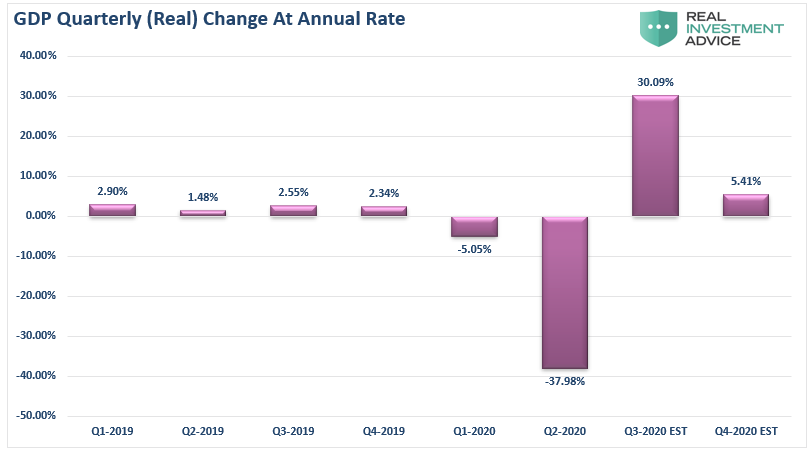
More Stimulus And The 2nd Derivative Effect Tyler Durden Sat, 10/10/2020 - 11:35 Authored by Lance Roberts via RealInvestmentAdvice.com, There is currently much hope for another fiscal stimulus package to be delivered to the economy from Congress. While President Trump recently doused hopes of a quick passage, there a demand for more stimulus by both parties. While most hope more stimulus will cure the economy’s ills, it will likely disappoint due to the “2nd derivative effect.” Let me explain. In March, as the economy shut down due to the pandemic, the Federal Reserve leaped into action to flood the system with liquidity. At the same time, Congress passed a massive fiscal stimulus bill that expanded Unemployment Benefits and sent checks directly to households. As shown in the chart below of the upcoming expected GDP report, it worked. (We estimated GDP to increase by 30% from the previous quarter.) That expected 30% surge in the third quarter, and surging stock market to boot, directly responded to both the fiscal and monetary stimulus supplied. The chart below adds the percentage change in Federal expenditures to the chart for comparison. The spike in Q2 in Federal Expenditure was from the initial CARES Act. In Q1-2020, the Government spent $4.9 Trillion in total, which was up $85.3 Billion from Q4-2019. In Q2-2020, it increased sharply, including the passage of the CARES Act. Spending for Q2 jumped to $9.1 Trillion, which as a $4.2 Trillion increase over Q1-2020. Those are the facts as published by the Federal Reserve. From this point forward, we have to start making some estimates and assumptions. Assuming CARES-2 During Q3-2020, not much happened as the Government was fighting over the next round of stimulus. As such, spending fell back to a more normal level of increase. However, if we assume that a second CARES Act is passed some time in Q4, and we apply a price tag of $2 Trillion to the package, it would represent a roughly 25% increase in Government spending over Q3-2020. Such is the “second derivative” effect we mentioned previously. “In calculus, the second derivative, or the second-order derivative, of a function f is the derivative of the derivative of f.” – Wikipedia In English, the “second derivative” measures how the rate of change of a quantity is itself changing. I know, still confusing. Let’s run an example: As Government spending grows sequentially larger, each additional round of spending will have less and less impact on the total. Going back to 2016, not including the CARES Act, the Government increased spending by roughly $50 billion each quarter on average. If we run a hypothetical model of Government expenditures at $50 billion per quarter, you can see the issue of the “second derivative.” In this case, even though Federal expenditures are increasing at $50 Billion per quarter, the rate of change declines as the total spending increase. More Leads To Less The next chart shows how the “second derivative” is already undermining both fiscal and monetary stimulus. Using actual data going back to the Q1-2019, Federal Expenditures remained relatively stable through Q1-2020, along with real economic growth. However, in Q2-2020, with our estimates for Q3 and Q4, Federal Expenditures will almost double. However, the economy will not return to positive growth. The chart below shows the inherent problem. While the additional fiscal stimulus may help stave off a more in-depth economic contraction, its impact becomes less over time. However, this is ultimately the problem with all debt-supported fiscal and monetary programs. Still In A Recession As I stated above, even assuming a $2 Trillion fiscal relief package by the end of October, which I suspect may not come, the relative impact on GDP growth will fall short of expectations. Take a look at the next chart. These are our current estimates for GDP growth over the next 3-quarters. These estimates dovetail reasonably nicely with mainstream consensus. At first glance, it appears that after one negative quarter of GDP, the economy is well back on track to normalcy. However, such an assumption would be incorrect. Given that we measure economic growth on an annualized basis, the three-quarters of positive change following such a steep decline still leaves the economy in a recession. Yes, add a couple of more quarters of economic growth, and you will eventually be back into positive territory. However, therein lies an even bigger problem. Dollars Of Growth Deteriorate As noted above, it requires increasing levels of debt to generate lower rates of economic growth. The chart below shows the previous and estimated CARES Acts and their impact on GDP growth. To understand this better, we can view it from the perspective of how many dollars does it require to generate $1 of economic growth. Following the economic shutdown, when economic activity went to zero, each dollar of input had a more considerable impact as the economy restarted. However, in Q4, economic activity has already recovered and begun to stabilize at a slightly lower level than seen previously. High-frequency data like credit card spending and main-street activity indicators tell us this is the case. Given that stabilization of activity, it will require more dollars to generate economic growth in the future. As shown, it will require $8.80 of debt-supported expenditures to create $1 of economic growth. Here is the exciting part. That is NOT a new thing. As I discussed just recently “The One-Way Trip Of American Debt:” The “COVID-19″ crisis led to a debt surge to new highs. Such will result in a retardation of economic growth to 1.5% or less, as discussed recently.Simultaneously, the stock market may rise due to massive Fed liquidity, but only the 10% of the population owning 88% of the market benefits. In the future, the economic bifurcation will deepen to the point where 5% of the population owns virtually all of it. As I noted previously, it now requires $7.42 of debt to create $1 of economic growth, which will only worsen as the debt continues to expand at the expense of more robust rates of growth. You Can’t Use Debt To Create Growth As noted above, more debt doesn’t lead to stronger rates of economic growth or prosperity. Since 1980, the overall increase in debt has surged to levels that currently usurp the entirety of economic growth. With economic growth rates now at the lowest levels on record, the change in debt continues to divert more tax dollars away from productive investments into the service of debt and social welfare. Another way to view the impact of debt on the economy is to look at what “debt-free” economic growth would be. In other words, without debt, there has actually been no organic economic growth. The economic deficit has never been greater. For the 30 years from 1952 to 1982, the economic surplus fostered a rising economic growth rate, which averaged roughly 8% during that period. Such is why the Federal Reserve has found itself in a “liquidity trap.” Interest rates MUST remain low, and debt MUST grow faster than the economy, just to keep the economy from stalling out. The deterioration of economic growth is seen more clearly in the chart below. From 1947 to 2008, the U.S. economy had real, inflation-adjusted economic growth than had a linear growth trend of 3.2%. However, following the 2008 recession, the growth rate dropped to the exponential growth trend of roughly 2.2%. Unfortunately, instead of reducing outstanding debt problems, the Federal Reserve provided policies that fostered even greater levels of unproductive debt and leverage. Coming out of the 2020 recession, the economic trend of growth will be somewhere between 1.5% and 1.75%. Given the amount of debt added to the overall system, the ongoing debt service will continue to retard economic growth. A Permanent Loss  As noted by Zerohedge, the permanent loss in output in the U.S. was shown by BofA previously. The bank laid out the pre-COVID trend growth and compared it to is base case recovery. Such aligns closely with our analysis shown above. Given the permanent loss in output and rising unproductive debt levels, the recovery will be slower and more protracted than those hoping for a “V-shaped” recovery. The “Nike Swoosh,” while more realistic, might be overly optimistic as well. However, this is the most critical point. The U.S. economy will never return to either its long-term linear or exponential growth trends. Read that again. Spit-Balled Solutions If you read between the lines, policymakers are “spit-balling” solutions and making potentially erroneous monetary policy decisions on unreliable data. However, given Central Banks’ only policy tool is more liquidity, it is a “shoot first, ask questions later” response.  The problem is those policy measures continue to erode economic prosperity. Such is evident when the CBO’s own long-term economic growth potential projections fall below 2%. Due to the debt, demographics, and monetary and fiscal policy failures, the long-term economic growth rate will run well below long-term trends. Such will ensure the widening of the wealth gap, increases in welfare dependency, and capitalism giving way to socialism. “So for the Federal Reserve to intervene and support those asset prices, is creating a little bit of moral hazard in a sense you’re encouraging people to take on more debt.” – Bill Dudley What policymakers haven’t come to grip with is the “second derivative” effects of more debt. At some point, you have to realize that you can’t get out of a “debt hole” by piling on more debt. Eventually, you have to stop digging.
http://dlvr.it/RjL6K5

North Korea Unveils "Previously Unseen ICBM" At Rare Military Parade  

North Korea Unveils "Previously Unseen ICBM" At Rare Military Parade   Tyler Durden Sat, 10/10/2020 - 10:22 North Korea held a rare predawn military parade on Saturday, marking the 75th anniversary of the country's ruling party, reported Reuters. Tens of thousands of spectators waved mini-North Korean flags and cheered when the country's leader, Kim Jong Un, emerged from a building between Friday midnight and the early hours of Saturday morning to give a speech.  While much of Kim's speech has yet to be translated, The Guardian says Kim told the audience he was grateful "not a single person" in the county has contracted COVID-19.  South Korea's joint chiefs of staff said "large crowds and equipment" had been mobilized to the Pyongyang region ahead of the event.  "There was a sign that North Korea conducted a military parade this morning at Kim Il Sung Square, mobilizing large scale equipment and personnel," it said in a statement. "South Korea and U.S. intelligence authorities are closely monitoring developments, including for the possibility that it was the main event." Outside observers (N.K. Pro Analyst Ankit Panda and Oryx analyst Joost Oliemans, as well as N.K. News journalists Chad O'Carroll and Jeongmin Kim), streamed the event with commentary on Saturday. They said North Korea unveiled the latest weapons that would concern Washington and its allies in the region.  The event was a show of force ahead of the U.S. presidential elections on Nov. 03, as denuclearization with the Trump administration has stalled.  Reuters said a "previously unseen new intercontinental ballistic missile (ICBM) was at a military parade in Pyongyang on Saturday."  "Edited footage shown on state television showed an ICBM on a transporter vehicle with at least 22 wheels, larger than anything previously displayed by the nuclear-armed country. It was the first time since 2018 that North Korea has shown ICBMs at a military parade," Reuters said.  Reuters also noted "commercial satellite imagery" in recent weeks has shown thousands of North Korean soldiers mobilizing in the area. The last time North Korea broadcasted a military parade was in 2017 when President Trump and Kim were at each other's throats. 
http://dlvr.it/RjKy1B

Why The Truth Behind Hunter Biden's Actions In Ukraine Matters To Us All

Why The Truth Behind Hunter Biden's Actions In Ukraine Matters To Us All Tyler Durden Sat, 10/10/2020 - 09:20 Authored by David Schoen via SaraACarter.com, It is understandable that any father would be uncomfortable discussing his son’s personal problems and ethical transgressions.  In that regard, Joe Biden is no different.  But Joe Biden is not just any father – he is the Democratic Party’s candidate for President of the United States.  And his son Hunter’s Ukraine issues are not just personal matters.  What then Vice-President Joe Biden knew about his son Hunter Biden’s dealings in Ukraine at a time when Joe Biden was the Obama administration’s point person for Ukraine, whether the Vice-President helped facilitate his son’s actions, and just what Hunter Biden did are all matters of public importance.  They impacted on the message our country sent around the world with respect to foreign affairs and our efforts to stamp out corruption.  And the underlying facts provide an important window into Democratic Party presidential candidate Joe Biden’s ethical compass. Calls for a full investigation into just what happened have rung out for many years from a variety of sources.  But not only have those calls been rejected, President Trump was impeached in large part for trying to force the issue and demand an investigation. His political opponents cast his demands that Ukrainian officials publicly investigate once and for all as an unlawful effort to use a foreign government to affect an election, using the excuse that Joe Biden was one of a large field of Democratic Party primary candidates.In fact, Trump haters in Congress carried this phony claim to the ultimate degree and used it to impeach the President, thereby demeaning the solemnity of the impeachment process and continuing to successfully bury the true facts surrounding the Biden Affair. And so all relevant questions remain unanswered.  The fact of the matter is, Joe Biden should have been leading the charge all of these years to demand a full investigation to clear him and Hunter of the taint that has continued to attend this matter.  Even an avid Trump hater like the Washington Post’s David Ignatius, earlier this year advised Biden to openly address these issues in his quest for the presidency.  The American people deserve no less.  In the recent presidential debate, Mr. Biden dismissed any questions about Hunter and claims of profiteering from his father’s connections to foreign leaders by saying it has all been debunked; but that just is not true and saying so, with some in the media parroting this false claim, there can be no closure. The American people need a full and thorough airing of the matter before the election so that we can factor this into our evaluation of the character and the politics of one who seeks to be our President.  So what do we know and what more do the American people need to know? To fully flesh out these underlying facts and circumstances, the American people deserve to hear, under oath, from the most fundamentally important witnesses.  From any perspective, these are Joe Biden, his son Hunter, and Devon Archer, Hunter’s business associate and a close friend of John Kerry’s family. It was the appointment of Hunter Biden and Mr. Archer to the board of a Ukrainian energy company, without any qualifications, and at a reported compensation package worth some $50,000 per month, that led the Wall Street Journal, on May 13, 2014, to publish a scathing article,  bringing the issue public, and suggesting that the matter raised a number of major red flags for a variety of reasons.  President Trump did not concoct a concern about these circumstances out of thin air to gain advantage in a political battle. The corruption allegations that were the subject of his phone call with Ukraine, long predated his presidency.  Some other mainstream media outlets since have written similar pieces, strongly arguing that the situation was very troubling and demanding further scrutiny and answers.  Recently, the Washington Post reported that John Kerry’s step-son, Chris Heinz, who founded an investment company with Mr. Archer considered the decision to join the Ukrainian company’s board to reflect such poor judgment and the appearance of impropriety so clear that he publicly disassociated himself from Mr. Archer and the company.  Mr. Heinz would be an important witness in any investigation, as would his step-father. A primary concern that has been raised, of course, is whether then Vice-President Joe Biden, the Obama administration’s point man for the Ukraine, acted inappropriately in continuing to oversee our relationship with the Ukraine and, specifically, for withholding aid to Ukraine based his perspective on how the Ukraine government was addressing corruption, with some charging that Mr. Biden was not happy that the company his son was associated with had come under scrutiny from a Ukrainian corruption prosecutor.  One leading expert on Russia and the region from the University of Wisconsin has written that the appearance of impropriety – specifically the desired appearance by the Ukraine that its policies must be in favor with the United States if the Vice-President’s son is on the board of a leading Ukrainian company – is so problematic that the relationship should have been avoided at all costs. Surely, no responsible person would argue that Joe Biden and his family should be exempt from scrutiny or should be given license simply by virtue of his candidacy for President.  Indeed, just the opposite is true. It is in our national interests for all candidates to be fully vetted and for any corruption allegations to be fully investigated.  Again, if he and his son are innocent, Joe Biden who should be demanding a full investigation by our government and the Ukraine to clear his name once and for all, now, while the world is watching.  Does Corruption in Foreign Affairs Really Affect Our National Interests? Since 1960, study after study on the advisability and impact of American foreign aid has cited corruption within the recipient country as perhaps the greatest determinative factor in whether aid should be given and, if so, what steps should be taken to address concerns about corruption.  Commentators who study such things regularly document the corrosive effect of corruption on several levels.  One recent U.N. Study concluded that roughly 30% of foreign aid money never reaches its intended final destination because of corruption. Corruption in recipient countries is a destructive force that often promotes more corruption, in effect institutionalizing it for generations.   Conversely, of course, foreign aid with strings, and specifically with demands for corruption reform can lead to improvements for the recipient country in both the short and long term and enhances the donor nation’s reputation – and its national security.  If aid is firmly conditioned on specific corruption fighting steps, our dollars are much more likely to reach the intended beneficiaries and theoretically, at least, the quid pro quo – fight corruption or get no aid – filters through politically, to drive from office those who perceive their self-interest as best served through corruption.  We cannot be a party, either actively or by acquiescence, to corruption; nor can we afford to have any country believe they can gain access to the highest levels of our government through corruption.  We must always be vigilant and that means a full investigation must be undertaken each and every time there is some credible reason to believe a recipient country is corrupt.  This is especially so when that corruption might well have affected policy coming from the White House.  That is a primary concern in the Hunter Biden affair.   The issue of Hunter Biden’s financial windfalls from the likes of Russia and China was, of course, front and center during the first debate between Messrs. Trump and Biden and, once again, Mr. Biden dismissed the issue out of hand and unqualifiedly asserted that these stories about his son getting paid millions by Russia or China were “totally false” and has so been proved.  But just last week, the Washington Times reported Treasury Department records actually confirm Hunter Biden’s receipt of a wire transfer in the amount of $3.5 million from the Mayor of Moscow’s wife – a person the United States suspects of attaining billionaire status through corruption.  There clearly is much more to this story than Mr. Biden’s summary dismissal would suggest and the media does a great disservice to the American electorate by indulging that dismissal.  The American people deserve to know the facts before they fill out their ballots.
http://dlvr.it/RjKppP

Friday, October 9, 2020

59 Million Americans Expect Income Losses Ahead Of Presidential Election  

59 Million Americans Expect Income Losses Ahead Of Presidential Election   Tyler Durden Fri, 10/09/2020 - 22:40 The Census Bureau's latest Household Pulse Survey speaks volume to the "K-shaped" recovery, where high-income Americans saw their jobs immediately return and "V-shaped" recoveries for stock and other asset prices, while middle- and lower-class people continue to experience job loss, food insecurity, unable to pay bills, and eviction or foreclosure.  The survey, conducted from Sept. 16-28, shows 59.2 million Americans expect someone in their household to have a loss in employment or take a pay cut ahead of the presidential elections. Bloomberg points out that the working poor, more specifically, minority households continue to struggle the most economically from the coronavirus pandemic.  ​ The survey found 32% of Americans were "somewhat" or "very" concerned about their ability to cover basic household expenses. These figures were alarmingly high for Hispanic and Black households.  ​ Minneapolis Fed President (as well as former Assistant Secretary of the Treasury for Financial Stability under the Bush and Obama administrations, former PIMCO and former Goldman Sachs employee) Neel Kashkari was out this week addressing the dire need for more stimulus to support the economic recovery.  "Whatever Congress can do with the executive branch -- come together aggressively to put money in the hands of people who have lost their jobs and to support small businesses so that we don't have this continuing wave of bankruptcies across the economy -- it's just vital that they move quickly," Kashkari told CNBC. On Thursday, House Speaker Nancy Pelosi signaled there wouldn't be any more financial support for airlines without a much larger stimulus package. Meanwhile, Senate Majority Leader Mitch McConnell said many Republican senators believe the economy has already seen enough stimulus.  With stimulus talks stalled, how is it that poor people and minority households continue to suffer while millionaires and billionaires are getting richer and richer?  Well, it has to do with the flawed economic system, as what the virus exposed for all the world to see, where monetary and fiscal stimulus flows directly to the wealthiest people, thus creating the "K" recovery. The "K" is the result of socialism and central planning - so far its been disastrous for the bottom tier of society. 
http://dlvr.it/RjJYQX

Gallup Finds Majority Say They Are Better Off Under Trump Than Obama/Biden

Gallup Finds Majority Say They Are Better Off Under Trump Than Obama/Biden Tyler Durden Fri, 10/09/2020 - 12:10 Authored by Steve Watson via Summit News, Pollster Gallup has found that a majority of 56% of Americans feel that they are better off now under Donald Trump’s presidency than they were four years ago under Barack Obama and Joe Biden. The survey recorded the highest number of Americans in history saying that they feel in a better position 4 years into an incumbent’s presidency: Source: Gallup Given that in all but one of the examples above, where the number is much lower than 56%, the incumbent was re-elected, the findings bode very well for Trump. The President responded to the findings in a tweet: The Gallup Poll has just come out with the incredible finding that 56% of you say that you are better off today, during a pandemic, than you were four years ago (OBiden). Highest number on record! Pretty amazing! — Donald J. Trump (@realDonaldTrump) October 9, 2020 While the majority is a good sign for Trump, the figure was even higher back in February, before the coronavirus pandemic. Back then, 61% expressed more satisfaction than they had four years previously. Given the current circumstances, it is rather startling to find that more Americans think they are better off now, and betrays how effective Trump’s presidency has been thus far. The only time an incumbent president has failed to be re-elected when seeking a second term since this question was first asked was H.W. Bush in 1992. The number of Americans more satisfied than four years previously in that instance was way down at 38%, nearly 20% less than has been recorded now. The idea for the survey originates in a question Ronald Reagan asked Americans during his presidential campaign in 1980, ‘Are you better off today than you were four years ago?’
http://dlvr.it/RjHBmj

2 More White House Residence Staffers Infected In Outbreak That Began Weeks Ago

2 More White House Residence Staffers Infected In Outbreak That Began Weeks Ago Tyler Durden Fri, 10/09/2020 - 11:25 The NYT has just pubished its latest scoop on the White House outbreak, which may have started days, or even weeks, before the Amy Coney Barrett ceremony. After revealing earlier this week that a senior White House security official was "gravely ill" after testing positive last month, the NYT has just broken news about a handful of additional infections. Now, the NYT is claiming that two additional White House residence staffers - who fall under the purview of the East Wing, which is typically controlled by the First Lady - have tested positive in an outbreak that began three weeks ago. This brings the total number of White House residence housekeeping staff who have been infected to 4 (that of course doesn't include the West Wing security official, who is reponsible for working with the Secret Service to hand out security credentials). Those infected so far include: three members of the housekeeping staff who work on the third floor of the residence, as well as an assistant to the chief usher, Timothy Harleth. Trump was reportedly warned about the positive tests when they first occurred, and Harleth reportedly advised the other sickened staff members to "use discretion" about who they tell.. It wouldn't be the NYT without alluding to its past reporting about Trump demanding that some of the senior officials in his administration take off their masks when they were worn in meetings. There's no evidence that Trump ever asked a member of the housekeeping staff to remove their masks.
http://dlvr.it/RjH3Hz