UK Court Decision On Venezuela Gold Deals Blow To Regime Change Efforts Tyler Durden Tue, 10/06/2020 - 08:51
Authored by Alan Macleod via MintPressNews.com,
A UK court ruled that the administration of Boris Johnson’s position that Juan Guaidó is the legitimate ruler of Venezuela is far from equivocal, paving the way for over $1 billion of the country’s gold to be released.
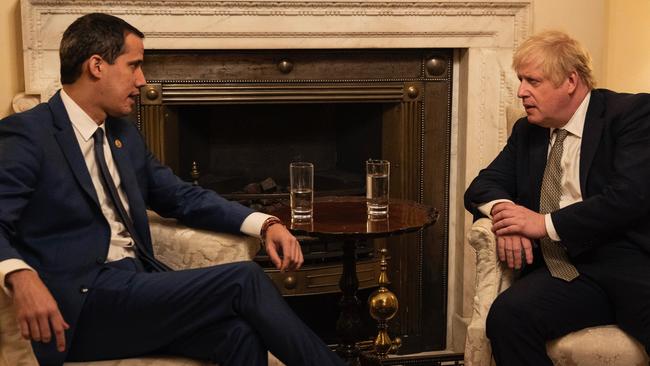
A United Kingdom court has handed the Venezuelan government of Nicolas Maduro a major win today, overturning a previous ruling from a lower court that legitimized the British government’s decision to freeze Venezuelan government gold reserves held in the Bank of England. The English Court of Appeal ruled that the Conservative administration of Boris Johnson’s position that Juan Guaidó is the country’s legitimate ruler was far from equivocal, potentially paving the way for some $1.95 billion of the Central Bank of Venezuela’s gold to be accessed.
Following President Trump’s lead, in July, the U.K. government took the extraordinary step of derecognizing President Maduro in favor of the self-declared Guaidó, despite the fact that for nearly six months, he had not even been a member of his Popular Will party, let alone its leader. The move was labeled “highway robbery” by supporters of the Venezuelan government.
A nearly unheard of politician before his ascension to the role of head of the Venezuelan National Assembly (a post given out on a yearly rotational basis among all parties in the institution) in January 2019, Guaidó shocked the country by using his appointment to unilaterally declare himself president of the country. He then led a series of coup attempts throughout 2019 and 2020, the last of which involved paying Trump-linked American mercenaries to shoot their way into the presidential palace. However, the plan ended in complete disaster, with the Americans subsequently sentenced to 20 years of prison time.
Guaidó based his claim to power on Article 233 of the Venezuelan Constitution, which allows a president to be removed if he “abandons his position” or becomes “permanently unavailable to serve” for whatever reason. Maduro, however, had clearly not left his post. Regardless, if he had, Article 233 states that the vice-president would take charge until a new election by universal suffrage was held. Guaidó’s party was not even registered to stand in elections, having boycotted them the year previously under U.S. orders. The Trump administration had attempted to organize a total boycott from opposition parties, thereby undermining the process’ legitimacy, even threatening to sanction opposition presidential candidate Henri Falcón. Despite the partial boycott, turnout was relatively high. A larger percentage of the total electorate still cast their ballot for Maduro than Americans did for Trump in 2016 or Obama in 2012. The U.S. government is currently trying the same tactic in the upcoming December elections to the National Assembly, the State Department releasing a memo in September declaring that all opposition parties taking place were considered “puppet parties” participating in an “electoral charade,” and would therefore be sanctioned.
The United Kingdom and the United States have been leaders in a years-long economic and political campaign to oust Maduro from power, hitting the country with sanctions and attacking it politically. When Maduro attempted to use the impounded gold to buy humanitarian aid from the United Nations to deal with the coronavirus pandemic, the Johnson administration blocked it. Meanwhile, American sanctions, declared illegal by the U.N., have been responsible for over 100,000 Venezuelans’ death. The U.S. government is also continually provoking Venezuela militarily. Last week, it sent a warship — the U.S.S. William P. Lawrence — into the Caribbean, just 16 nautical miles from Venezuela’s coast. Defense Minister Vladimir Padrino described the action as “erratic and childish,” implying Trump was attempting to foment an “October Surprise” conflict to boost his reelection chances.
The U.S. has also funded and supported Guaidó throughout his coup attempts, grooming him since he was a student leader. Recently, they have been channeling money confiscated from the Venezuelan government to Guaidó so that he can personally pay every healthcare worker a huge stipend.
While the Maduro administration is very unpopular, the opposition has had little success shaking their image as elitists interested only in returning Venezuela to its former status as a U.S. client state. Guaidó is presented in Western media as a breath of fresh air and a break with that tradition. However, as the privately-educated son of an international airline pilot, and somebody who attended George Washington University (an impossible task for those who do not come from the elite), he has had little success persuading his countryfolk to get behind his vision for the country. A recent poll found that 3 percent of Venezuelans recognize him as president. Despite this, he has received virtually unanimous support in Washington and London. However, there is no doubt that today’s court ruling is a loss for him and a win for Maduro.
http://dlvr.it/Rj38sL
Tuesday, October 6, 2020
Monday, October 5, 2020
It's JOEtime
It's JOEtime Tyler Durden Mon, 10/05/2020 - 11:15
Submitted by Adventures in Capitalism,
Back in June of 2018, I wrote an initial piece on St. Joe (JOE – USA), owner of approximately 175,000 undeveloped acres along with assorted commercial real estate on the Florida Panhandle. My thesis was that the stock was trading at $18 and the land was worth a few times that figure. However, without a catalyst, I lost interest and focused on other investments with immediate catalysts. Normally this would be the end of the story; just another value stock trading at a fraction of fair value, lost in an ocean of value stocks. However, a lot has changed in two years and JOE is now my largest position. I think fair value today is north of $100 and it likely trades for a few hundred a share over the next decade. As a result, I thought an update was in order.
Back in May, when my mayor turned Miami Beach into a COVID penal colony, I fled north—to the Panhandle where beaches and bars were still operating normally. I hadn’t been there in two years, but the change was dramatic. There were new property developments popping up everywhere. Even with COVID, everything was crowded, clearly change was afoot. Maybe this shouldn’t have been such a shock to me. I had been reading about all the projects that JOE had on the go, I had seen the rapidly increasing revenues and cash flow, but until I was there, I couldn’t fully conceptualize it. The Panhandle is growing like mad and JOE is at the epicenter of all of it.
I have spent two decades of my life watching micro-trends, trying to catch the moment when they inflect. I don’t think I have ever before seen so many powerful trends converging on one stock in my career. To start with, you have inflation which is about to roar and land is one of the best protections against inflation. Then, you have population migrations. You have the flight from high-tax states to Florida with zero state income tax. You also have the flight from urban areas with their increasing violence and chaos, towards suburban areas. Finally, as “Project Zimbabwe” pushes asset prices into the stratosphere, those who are already long assets will increasingly be wealthier and purchase more expensive homes, which pushes JOE’s resale prices and margins higher as well. It’s all a virtuous cycle now as the Panhandle has finally hit the critical mass where it has a gravitational pull for high-end residents along with the amenities that they want. Homes on the dunes
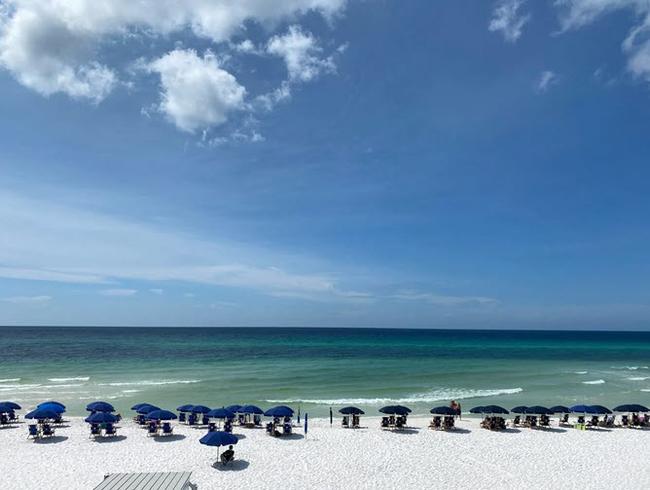
Conceptually, I think of the land that JOE owns very much as the Hamptons out on Long Island. I remember going there as a kid and it wasn’t much more than potato fields, but as crime went crazy in NYC, the Hamptons became the playground for the 1%. If you owned those potato fields and turned them into high-end estates, you made an absolute fortune. JOE is about to repeat that but on a much grander scale as the Panhandle is already the Hamptons of the South—it’s mile after mile of multi-million dollar homes (see picture above).
In keeping with long-standing tradition on this site, I’ll focus on themes without getting bogged down by the numbers (that’s your job as analysts). If you want to understand how to value JOE, I recommend reading a write-up by my buddy, David Spier, from Nitor Capital Management on Seeking Alpha (sorry it’s behind a paywall). He’s cataloged all the data much better than I ever could. Dozens of forested lakes next to the beach
People who know me well, may wonder why I’m so fixated on JOE, given that I tend to seek out high-torque investments and land plays are by definition slow-moving. The counterpoint is that I don’t know many companies that are growing revenues and earnings at 30 to 50% a year with a clear line of sight for years into the future. Even better, JOE trades at about ten times my estimated 2021 Funds From Operations (FFO) and a mid-single digit FFO multiple looking out a few years further. Even worst-in-class REITs have higher forward multiples, despite negligible growth prospects and high financial leverage, meanwhile JOE has a net cash balance sheet. Therefore, even just stepping up to near current fair value leads to a multi-bagger. Besides, I think the rapid revenue growth that they’ll report in 2021 finally gets JOE noticed. If not, when they sell out phase one of their Margaritaville development in the first few days, it ought to turn some heads as it will capitalize some of the supposedly least-valuable acres at nearly $100,000 each. Remember how the shortsellers keep saying that they’re only worth $1,000 each? In summary, these are SAAS-like growth rates at a pedestrian FFO multiple and you get the land-bank, worth a few times today’s quote for free.
Using inexact precision, let’s say that the land appreciates at 5% a year; if the land-bank is worth $100 a share today, that’s $5 per share in appreciation to equity annually. Add in the roughly $2 in FFO and you’re getting $7 a share on today’s $21 price. That’s a 33% return annually, even before management reinvests that capital at high rates of return or repurchases more shares (they’ve been buying back a few percent of the shares each year at less than 20% of fair value). I don’t know of any other opportunities with such high rates of return with such negligible downside, especially as I think management here is top notch. Meanwhile, I get a free look at much higher future rates of inflation through all the land ownership. As I think about JOE, I almost wonder why more people do not replace some of their gold with JOE—I know I have, as it’s a better way to play the same outcome but with more ways to win and a much lower starting point in terms of valuation.
For me, JOE is the ultimate “forever compounder” and as more of the investment community wakes up to that fact, I suspect that the shares will appreciate towards fair value and probably well past fair value as they price in the inevitable growth of Florida. As a result, I’ve made JOE my largest position, particularly as the downside is so negligible and the upside is measured in many multiples of today’s quote. That said, please remember, this is a very long-term play—do not expect immediate fireworks here.
On a final note, I recently spoke about JOE on my monthly Kuppy Korner on Market Huddle. (My friends Kevin and Patrick do a great job keeping finance interesting and I highly recommend that you tune in each week). I start speaking at 1:08:00 and my JOE comments start at 1:17:30.
http://dlvr.it/Rhzx2q
Tropical Storm Delta Forms As Gulf Coast On Watch For Possible Late Week Landfall
Tropical Storm Delta Forms As Gulf Coast On Watch For Possible Late Week Landfall Tyler Durden Mon, 10/05/2020 - 11:00
Here we go again. Another tropical cyclone threat could make landfall in the northern U.S. Gulf Coast later this week. Readers may recall, the 2020 Atlantic hurricane season has been unusually busy (read: here). The season runs from June 1 through Nov. 30, and as we discussed weeks ago, the remaining two months of the season could remain active.
The National Hurricane Center (NHC) released a statement Monday morning outlining how Tropical Storm Delta could strengthen into a hurricane with potential landfall impacts in the northern Gulf Coast later this week.
"Tropical Storm Delta Advisory 3A: Tropical Depression Strengthens Into a Tropical Storm. Additional Strengthening Likely Over the Next Few Days," the National Hurricane Center (NHC) said in a tweet.
Tropical Storm #Delta has formed over the northwestern Caribbean Sea. Additional strengthening is likely and the system is expected to be at or near hurricane strength when it pass near or over western Cuba late Tuesday or early Wednesday. Latest at https://t.co/tW4KeGdBFb pic.twitter.com/qBJJdAh6Ze — National Hurricane Center (@NHC_Atlantic) October 5, 2020
Dela is centered near Jamaica early Monday morning, moving west-northwest at ten mph, could become a Category 1 on Wednesday as it moves near western Cuba. Weather models then show the system hooking right on Thursday and strengthening to a Category 2, for potential landfall on Friday. As for pinpointing the exact location of landfall remains uncertain, but the greatest possible impact areas are somewhere between Louisiana into the Florida Panhandle.
"Delta could interact with Tropical Storm Gamma for a period of time later Tuesday through Wednesday as it tracks into the Gulf of Mexico. That interaction might have some effect on the future track and intensity of Delta; however, details are uncertain," The Weather Channel said.
It's too early to determine Delta's exact landfall location and impacts it will have, but readers should follow the storm's developments as the week progresses.
http://dlvr.it/RhzsBL
Dutch Govt: "Wear A Mask!"; Chief 'Scientist' - Don't Bother!
Dutch Govt: "Wear A Mask!"; Chief 'Scientist' - Don't Bother! Tyler Durden Mon, 10/05/2020 - 09:34
Authored by Raul Ilargi Meijer via The Automatic Earth blog,
Though I don’t follow the news in the Netherlands much, I happened to see something the other day that I think is a “beautiful” example of why so many countries get their “measures” wrong, their lockdowns, facemasks etc.
First of all, they all screwed up their initial lockdowns, which pretty much were March-June all over. And second lockdowns are more something they like to threaten people with than actually considered options. Unless things really get out of hand, if for instance numbers of deaths suddenly increase a lot, but given the change towards infections occurring in much younger people than before, that is not likely. Plus, of course, no-one wants even more economic damage.
And now what you see is the politicians don’t know what to do anymore. They turn to “their scientists” again, but many have before given advice that is different from what they say now, that hasn’t worked, and that often contradicts what their colleagues in other countries say. And so everyone starts blaming “the people”.
But the people have mostly obeyed the lockdowns and become experts themselves, or so they think, and seen them go nowhere. That makes the positions of politicians and “experts” much weaker than it was 6-7 months ago. It’s about credibility, and they’ve squandered it. Why “must we listen to the scientists” if that does us no good?
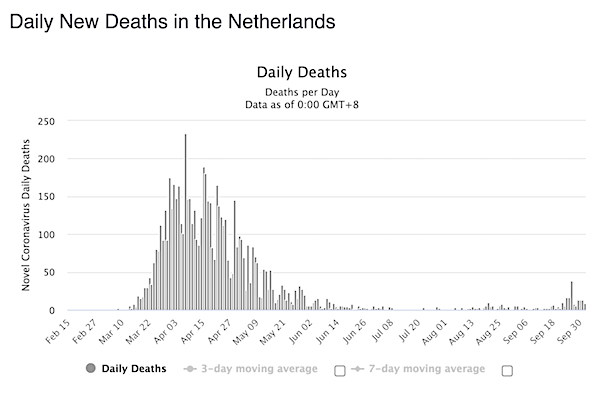
The Netherlands, like many European countries, is in a second wave that is seeing many more new daily cases than in spring. Partly due to more testing, but not entirely:
The number of deaths does not show a similar trend, which can be contributed to the infections mostly occurring in much younger people, and of course a better understanding in medical circles of the virus. However, hospitals are still filling up much faster than in June-July, and many younger people, too, end up with damaged brains, lungs, hearts etc.
This recent chart of the difference between August and September infection numbers throughout Europe is skewed because of the insane increases in Hungary and Georgia, but it shows that a 300% increase was entirely normal in that timeframe.
So what now?
The Dutch government came with a whole new set of measures starting October 2. Because people “don’t obey the rules”. And people increasingly say: maybe the rules are not right. By the way, facemasks are not mandatory there in stores and other public places, there is only an “urgent” government advice to wear them. That is different from many other nations. Here are the new measures per Google Translate:
*
Work from home as much as possible.
*
Receive up to 3 guests at home.
* Children up to and including 12 years are not included.
*
You may meet with a group of 4 people.
*
For example in a cinema or restaurant.
*
Children up to and including 12 years are not included.
*
A maximum of 30 people may be together in an indoor space.
*
Children count.
*
Cafes, bars and restaurants close at 10 p.m. You must be gone then. You can enter until 9 p.m.
*
You provide your name and telephone number. If someone gets sick who has been in the restaurant or cafe, you will receive a call.
*
You must make a reservation to visit a museum or library.
*
Stores only allow customers if there is enough space.
*
In supermarkets there will be special shopping hours for the elderly and the sick (people with poor health).
*
People with a contact profession must register customers. For example hairdressers.
The first reaction that I have, and I’m sure I’m not the only one: Why 3 people as house guests and not 4? Why 4 people at a restaurant table and not 5, or 30 total in an indoor space? There are family members we haven’t seen since Christmas, but a birthday party is out?
Where do those numbers come from? Did you just make them up? Also, closing bars and restaurants at 10 pm is going to be the death knell for many of the few that are left. Is that worth it?
About that number of 4 people at a restaurant table, the next article from NLTimes about worries in the hospitality sector says that in neighboring Germany and Belgium, 10 people can sit at that same -or preferably a bigger- table. Are Dutch people supposed to drive to those countries if they have a party of 8?
Gov’t Advice To Wear Masks In Public Space Met With Skepticism
On Wednesday Prime Minister Mark Rutte issued the urgent advice for all Netherlands residents to wear masks in publicly accessible indoor spaces. This advice was met with skepticism, especially from the hospitality industry. Former RIVM director Roel Coutinho would rather have seen a mask obligation instead of advice.
Hospitality association KHN doubts whether the advice to wear masks in public makes sense, the association said in a press release. “The fact that there is still no scientific substantiation by the cabinet and RIVM about the proven usefulness of face masks certainly does not help to create and maintain support. Moreover, face masks still form an extra barrier to visiting establishments.”
If the government turns its advice into an obligation, the KHN wants the Netherlands to follow Germany and Belgium’s example. According to the association, in those countries up to 10 people are allowed at a restaurant table. “Then we will be open to it,” the association said. The KHN also wants extra financial support should masks become mandatory.
Roel Coutinho, who preceded Jaap van Dissel as head of public health institute RIVM, is pleased that the advice to wear masks indoors now applies to the whole of the Netherlands, but regrets that the government did not make it mandatory. “On the basis of all the literature, I am convinced that wearing a face mask is useful. But only advice makes it particularly difficult for people,” he said to Nieuwsuur. “An obligation, as is also happening in countries around us, gives everyone much more clarity.”
An obligation will also help the stores that have to enforce the face mask rule. “Because what exactly should those shops or supermarkets do?” Coutinho said. “Because it only concerns urgent advice, the responsibility now lies with shops, which makes it very difficult. An obligation is not always pleasant, but it is clear and easy to enforce.”
But the best part is the following, the initial piece that got me thinking about this.
Turns out that at the same moment the government issues an “urgent” advice to wear them, with a threat of making them mandatory, its chief Infectious Diseases expert, the Dutch Fauci, says he sees little benefit is wearing non-medical masks. As, ironically, Fauci, who used to say they were useless, now calls them very beneficial.
Google translate again:
Van Dissel Insists: Ordinary Face Masks Have Little Effect
The frequent use of masks in other countries, the pressure of public opinion in his own country, or even a direct appeal from his famous American counterpart Anthony Fauci: Jaap van Dissel sticks to his position. When asked, the director of Infectious Diseases at the RIVM repeats that, according to him, masks have “an exceptionally small effect” on the attempts to contain the spread of the corona virus. In an interview with the NOS, he calls the cabinet’s recent decision to urgently recommend masks in public indoor spaces, therefore primarily a political decision rather than one based on medical grounds.
Since the start of the corona crisis, Van Dissel has emphasized that he sees little benefit in wearing non-medical face masks, especially because it could evoke a sense of false security and possibly divert attention from other rules. Although he acknowledges that there are studies that signal a positive effect of face masks, he believes they are difficult to extrapolate to the corona crisis.
“For example, medical mouth masks were often used in those studies and measures such as the one and a half meters are not taken into account,” he explains. There are also studies that are less positive about masks, he says. “That leads us to consider that we have not given a positive advice about it. That is just the story. That another decision is taken, based on political considerations, that it should be so.”
In addition, according to Van Dissel, the alleged effectiveness of non-medical face masks is nothing compared to the usefulness of other measures such as keeping sufficient distance from each other, washing hands regularly and staying at home in case of complaints. Earlier this week, the Outbreak Management Team, the advisory body of the cabinet which Van Dissel chairs, made some adjustments to the advice on face masks for the first time.
For example, the OMT wrote that masks could be recommended in places where sufficient distance from each other cannot always be kept “such as in busy shops”. For the same reason, a mask has been mandatory in public transport since June. According to Van Dissel, the change in the OMT advice has nothing to do with a changed view of mouth masks, but more to do with people’s sense of safety. “Of course, as OMT, we have also realized that some people would prefer to wear a mouth mask. If someone feels safer, we are fine with that,” he says.
The government says: wear a mask, and its chief scientific adviser says: don’t bother. Great message. And people don’t miss that. I’ve said it before: every government today should have a generous supply of N95 masks ready. They don’t because their experts long said they were not necessary. While some keep claiming cloth masks are useful, but “more to do with people’s sense of safety”.
I don’t know about you, but all these people with these useless masks on where they’re not needed, like outside, don’t make me feel safe at all. They make me think I’m surrounded by fools. And is anyone going to believe that 4 at a table is better than 10? How can they when just across the border the opinion is so different? If you ask me, the time of being able to order your citizens around on what to do and what not, may be ending for many governments. And they have only themselves to blame.
The only realistic thing to do at this point appears to be to give people back their own responsibility. If only because taking it away from them didn’t work.
* * *
We try to run the Automatic Earth on donations. Since ad revenue has collapsed, you are now not just a reader, but an integral part of the process that builds and maintains this site. Click here for Patreon donations. Thank you for your support.
http://dlvr.it/Rhzbcg
Regal-Owner Cineworld Could Suspend All US, UK Operations Next Week
Regal-Owner Cineworld Could Suspend All US, UK Operations Next Week Tyler Durden Mon, 10/05/2020 - 08:46
Cineworld, a British cinema company and the world's second-largest movie theater chain, is expected to close all of its US movie theaters this coming week, after a brief reopening in mid-summer, according to WSJ, citing a source familiar with the matter.
The final decision to close more than 500 US theaters could be announced as early as Monday or Tuesday, the source said. Cineworld operates US theaters under the Regal brand, the largest and most geographically diverse theater circuits in the US, consisting of 7,211 screens in 549 theaters in 42 states. Regal began reopening theaters in July/August as public health restrictions eased, but indoor capacity was limited.
Readers may recall, in mid-September, even though Hollywood released Christopher Nolan's "Tenet," that didn't necessarily mean consumers flocked back to indoor commercial spaces to watch the flick as the virus pandemic showed little signs of abating. Shown below, one Regal theater in Baltimore was a 'ghost town' around the release of Tenet.
No one at the movie theater. pic.twitter.com/uJrDo7KZZp — Alastair Williamson (@StockBoardAsset) September 12, 2020
Potential drivers behind the closures, which by the way, the source said "isn't definite," could be due to low foot traffic at theaters; it actually might make sense for theaters to shutter operations, layoff employees, tap the equity or debt markets, and formulate a relaunch plan when a vaccine is commercialized. Otherwise, as seen this past summer, a premature reopening will be perceived by consumers as irresponsible.
Another driver could be the lack of big-budget film releases, with the new James Bond movie, "No Time To Die," had to postpone its release to 2021. With the lack of exciting films and consumer behavior shunning indoor theaters, there's really no need to keep theaters open.
According to Reuters, Cineworld warned investors on Sept. 24 that it may have to raise a second round of cash early next year if the coronavirus pandemic persists. The movie theater operator had enough funds to keep operating after reporting a massive $1.6 billion loss for the first six months of 2020 as revenues crashed by 67%.
"There can be no certainty as to the future impact of Covid-19 on the group," Cineworld said in a statement.
The anemic box office open is more evidence that consumers aren't ready to step back inside theaters anytime soon. The National Association of Theatre Owners (NATO) outlined smaller theater chains face a bankruptcy wave:
"If the status quo continues, 69% of small and midsize movie theater companies will be forced to file for bankruptcy or to close permanently," NATO wrote in a written statement.
Suspending operations could be Cineworld's best bet to survive the virus pandemic. It's only a matter of time before other large chains do the same.
http://dlvr.it/RhzRfr
Sunday, October 4, 2020
The Police Are Requesting Data From People's Smart-Speakers At An Alarming Rate
The Police Are Requesting Data From People's Smart-Speakers At An Alarming Rate Tyler Durden Sun, 10/04/2020 - 22:05
Authored by Robert Wheeler via The Organic Prepper blog,
Remember all those conspiracy theorists and Luddites who told you they didn’t want Echo or Alexa devices in their home because those gadgets were spying on them? Well, they were right. That’s not even up for debate.
If you were one of those friends who mocked them and called them crazy, you were wrong. Just admit it.
If you are bewildered by what you just read, please, read on.
Nearly ten years ago, writers like Brandon Turbeville and others were warning that “smart technology” and the “internet of things” were being developed for surveillance and manipulation purposes. (Despite the companies’ claims of greater convenience.) We’ve been in a virtual dragnet for years.
Those devices and technologies are ubiquitous and are being used to soak up data, private and personal conversations, interactions, and even movement. All of this openly discussed in mainstream outlets. Lately, this website has reported on the Nest, your phone’s location tracker, and other “smart” technology. We’ve even talked about how we all have “surveillance scores.“
Take a look at WIRED’s article by Sidney Fussell, “Meet the Star Witness: Your Smart Speaker.” In this article, Fussell details a murder case in which an Amazon Echo device was presented as evidence.
He writes,
In July 2019, police rushed to the home of 32-year-old Silvia Galva. Galva’s friend, also in the home, called 911, claiming she overheard a violent argument between Galva and her boyfriend, 43-year-old Adam Crespo. The two lived together in Hallandale Beach, Florida, about 20 miles from Miami.
When officers arrived, Galva was dead, impaled through her chest by the 12-inch blade at the sharp end of a bedpost. Police believe Crespo tried to drag Galva from their bed. She held onto the bedpost to resist, but the sharp end snapped, somehow killing her. Police charged Crespo with second-degree murder. He pleaded not guilty and was released on $65,000 bail, awaiting trial. In the months since the arrest, Crespo’s lawyer has presented a surprising piece of evidence in his defense: recordings from a pair of Amazon Echo speakers.
“I had a lot of interviews where people said, ‘Oh, are you aware that this could be the first time Alexa recordings are going to be used to convict somebody of murder?'” says Christopher O’Toole, Crespo’s lawyer. “And I actually thought of it the opposite way, that this could be the first time an Amazon Alexa recording is used to exonerate somebody and show that they’re innocent.”
When police and prosecutors collect smart home or speaker data, it’s typically used as evidence against suspects. The Hallandale Beach Police Department filed a subpoena for Crespo’s speakers, as they may have picked up audio of the argument Galva’s friend overheard.
The incident shows the growing role of smart home devices and wearables in police investigations.
In 2016, police in Bentonville, Arkansas, requested Amazon Echo data in connection with a man’s death, believed to be the first such request. Amazon initially tried to block the request, but later handed over the data. A murder charge against the defendant was later dropped, but the speaker, smart home, and wearable data has figured into multiple cases since then.
Requests for smart and wearable data has increased rapidly.
Fussell continues,
Earlier this month, Amazon said it had received more than 3,000 requests from police for user data in the first half of this year, and complied almost 2,000 times. That was a 72 percent increase in requests from the same period in 2016, when Amazon first disclosed the data, and a 24 percent jump in the past year alone.
Amazon doesn’t provide granular data on what police are seeking, but Douglas Orr, head of the criminal justice department at the University of North Georgia, says police now look for smart home data as routinely as data from smartphones. Data on a smartphone often points officers towards other devices, which they then probe as the investigation continues.
By amending a search warrant, police can “keep going to keep collecting data,” Orr says. “That usually leads to an Echo or at least some other device.”
As Orr explains, officers are getting more savvy about smart home devices, creating templates that simplify requesting data. Police departments often share these templates, he says, tailoring requests for the specifics of the case they’re investigating.
Google’s Nest unit reported increasing police demands for data from its smart speakers through 2018. Google then stopped reporting Nest data separately, including such requests in its broader corporate transparency report, which shows increased requests for Google user data.
In their terms of service, most major apps and websites include a clause warning users that companies may hand over their data if requested by the government. Law enforcement agencies file subpoenas or search warrants for data, detailing to judges what evidence they expect to find on the devices and how it may serve the investigation. Amazon and Google both notify users of a request for data unless the order itself forbids it. Any number of entities can request user data, but the companies say they prioritize requests based on urgency.
“Things like Homeland Security, they’re going to take high priority,” explains Lee Whitfield, a forensic analyst. “Other law enforcement requests will come in under that. And then things like divorce cases or civil cases, they have a lower ranking.”
In an emailed statement, an Amazon spokesperson said the company “objects to overbroad or otherwise inappropriate demands” from law enforcement and referred WIRED to its policy on government requests. A Google spokesperson also referred WIRED to its updated policy on requests.
Forensic experts tell WIRED that information from the devices is valued because it can offer a timeline of a person’s activities, their location, if they’re alone, and can verify statements made during questioning.
. . . . .
Orr has studied the types of data police can pull from smart speakers like the Amazon Echo. “Voice clips are only the beginning,” he says. Speakers keep time-stamped logs of user activity. Police can examine these logs to get a sense of what someone was doing around the time of an alleged crime.
Fussell then provides another example of how these devices are used by law enforcement.
He writes,
Consider a potential suspect who can’t prove where they were at 11 pm on a Thursday, because they live alone. Something as simple as ordering pizza through a speaker would show the time and location of the request and, if voice recognition is enabled, who made the request. “It might be benign information that someone was ordering a pizza, but it might also be an alibi for somebody,” Orr says.
Police increasingly rely on wearables and smart devices to verify the claims people make during an investigation. Sometimes, the tools can reveal a lie.
Heather Mahalik, a forensics instructor, recalls a Florida case in which a man killed his wife, then tried to impersonate her. The husband sent texts and Facebook messages from his wife’s phone in an attempt to blur the timeline of her disappearance. While the woman’s phone activity continued, her Apple Watch showed a sudden drop in heart rate activity that the husband claimed was due to a dead battery. Activity on the man’s phone synced perfectly with when he used the wife’s phone to post to Facebook. Her phone showed no activity except for when the husband picked it up to post, with timestamps matching his activity to the use of the wife’s phone.
“We were able to tell from his device that he would pick up the phone, take 18 steps, and it corresponded with the time he posted a Facebook post,” Mahalik says.
Connecting information from multiple devices is a common practice, analysts say. Information on one device can suggest evidence on another. This ability to string together discoveries leads to what another expert calls a phased approach to digital forensics.
“They ask for something, the investigation moves along, they find something else interesting, and then they request the next thing,” says Whitfield, the forensic analyst.
O’Toole, Crespo’s lawyer, says police subpoenaed Crespo’s social media accounts right away, then requested his voice recordings about four weeks later. Officers wrote in the search warrant that the speaker data may include “audio recordings capturing the attack on victim Silvia Crespo.”
O’Toole says he intends to introduce the smart speaker recordings in his client’s favor. Via email, a spokesperson for Hallandale Beach Police confirmed the case was still active but did not provide further comment.
O’Toole says smart speaker recordings are part of several cases he’s working on, including a divorce in which a woman subpoenaed data from a smart speaker that may have picked up the sounds of her husband with another woman..
Whitfield says police are becoming more savvy about the information in the smart speakers’ activity logs. He recalls a case where police found drugs in a household with multiple residents. Officers identified a suspect after seizing data from a smart speaker. Its log not only listed recent queries related to drugs but identified who spoke them. Google and Amazon speakers let users create profiles so the devices recognize their individual voices. This information helped police identify the suspect.
“I just don’t see this going away,” Whitfield says. “I think this is going to be more and more prolific as time goes on.”
Whitfield is right.
It will never go away.
Advertisement of these technological devices as a tool for convenience was a manipulative tactic to introduce technological devices for their real purpose – the tracking, monitoring, and recording of citizens so that no action – no matter how small – goes unnoticed. We are already living in a surveillance state and it’s only going to get worse.
Once begun, this bell cannot be unrung.
http://dlvr.it/RhxvrL
Subscribe to:
Posts (Atom)