Sunday, October 4, 2020

Hawaii Food Bank Sees "Stunning" Increase In Meals Served 

Hawaii Food Bank Sees "Stunning" Increase In Meals Served  Tyler Durden Sun, 10/04/2020 - 11:09 Hawaii is facing an economic cliff as federal stimulus money for small businesses and unemployed workers have dried up (read: here). This past summer, there was some optimism in restarting Hawaii's tourism industry, but the resurgence in COVID-19 cases in July and August changed all that. High unemployment and a collapsed tourism industry continue to plague the island. Carl Bonham, executive director of the University of Hawaii Economic Research Organization, told Honolulu Civil Beat that the island's economic situation "is, to some extent, worse than we anticipated."  The virus-induced recession on the island has been so severe that Hawaii Food Basket, one of the island's top food banks, "has significantly increased its services since the start of the coronavirus pandemic, serving up to 80,000 people monthly," according to The Hawaii Tribune-Herald.  This time last year (Septmember 2019), the food bank provided assistance to around 14,000 individuals a month, representing a 5.7x increase over the year. Food Basket executive director Kristin Frost Albrecht said the food bank helps residents by providing care packages to a network of partner agencies and programs.  Albrecht said at one food bank site on the Big Island, the facility serves 2,000-3,700 people, where 85% of them are unemployed.  "The one thing I will say about The Food Basket — we are experienced with crisis," she said. "In the last couple of years, we've had hurricanes and lava, but there's been nothing like this. (Those disasters have) helped ease us into this new normal of what we're doing, but it's a stunning number. There are no two ways about it." And the "new normal" Albrecht speaks of consists of a country where the working-poor is entirely reliant on local food banks.  As we've outlined in recent weeks, food bank demand, on a national level, is rising once more: * De Blasio's 'Utopia'? Quarter-Mile Food-Bank Line Spotted In Queens * Dramatic Photos: Desperate For Provisions, Thousands Of Cars Line Up At Texas Food Bank * Massive Lines Form Outside Virginia Food Bank As Demand Hits One Million Meals Per Month * Wisconsin Food Bank Warns: "We're Not Going Back To Normal Anytime Soon"
http://dlvr.it/Rhwl01

Does It Matter To Markets Who Wins The Election?

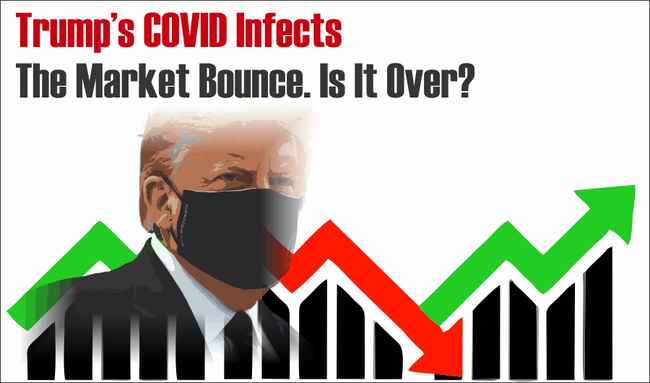
Does It Matter To Markets Who Wins The Election? Tyler Durden Sun, 10/04/2020 - 10:45 Authored by Lance Roberts via RealInvestmentAdvice.com, Market Catches Trump’s COVID Infection Everything was working according to plan this week, until Friday morning. As news hit that President Trump and the First Lady contracted COVID-19, so did the market at the open with Dow down roughly 450 points. Last week’s missive “The Selloff Is Overdone,” noted the decline was orderly and not one of a “panic” induced rout. “While the sell-off in the market has gotten overdone short-term, we still suggest using rallies back to the 50-dma to rebalance portfolio risks. If the market can break above resistance on Monday, clear the 50- and 20-dma’s, then old highs should not be an issue.“ As shown below, the market did only “some” of the hard work by holding the previous resistance level, making it support, breaking out of the downtrend, but failing to clear the 50-dma. Such is an improvement from our last analysis but keeps downside risk elevated going into next week. Notably, while the rally that we have witnessed from the recent lows has eaten up a fair bit of the previous oversold condition, the MACD “buy signal” was triggered on Friday. Such suggests that we could see some additional buying next week. However, again, with the failure at the 50-dma, such means continuing to use rallies to rebalance risks accordingly. With the election already a concern, no fiscal stimulus on the way, and rising weakness in the economic data, we added a short-market hedge to portfolios on Friday to reduce our equity exposure over the next few days as a precaution. That is just part of our risk management process. Does It Matter Who Wins The Election? I got a lot of emails following our previous discussion on market performance during Presidential election years. The basic premise of these emails was: “Yes, but if Biden wins the election, the market will crash.”  I understand. But let’s remember that in 2016, the media claimed that if Trump won the Presidential election, the market would crash. It didn’t. Yes, Biden’s proposed tax changes, green energy plans, and Government takeover of “healthcare” would indeed be bad for the markets. Such policies would weaken corporate profitability, specific sectors (energy and healthcare) would come under stress, and the surge in debt will make the Fed’s programs less effective. However, the reality is that while Presidential candidates make lots of claims on the campaign trail, it is Wall Street that ultimately dictates the eventual outcomes. Such is why many suggest that our Congressmen wear racing jackets to see who is sponsoring them for office. If you think for a moment that Congress comes up with, and writes, bills on their own, you are sadly mistaken. They are not that smart. Such is why whenever bills come to the floor for a vote, they always favor the group or industry whose lobby wrote and promoted the bill in the beginning. I am not cynical. It is just how the Government works. From a policy change perspective, assuming Joe Biden wins the November election, Trump remains in office until January 20th of 2021. That gives the market roughly 3-months to begin pricing in what the expected policy impact will be. Time is always kind to the market. It is still the quick, unexpected, exogenous events, like shutting down the economy, that markets do not take kindly too. Presidential Election Returns Historical market data also confirms the same. While I detailed the historical data previously, Dan Clifton of Strategas Research Partners also shows the markets don’t care much about election outcomes. His data is interesting as it shows how stock market performance leading up to an election has been an indicator of the outcome. The performance of the S&P 500 in the three months before an election has predicted 87% of elections since 1928 and 100% since 1984. When returns were positive, the incumbent party wins. If the index suffered losses in the three-month window, the incumbent loses. For now, the market is favoring a Trump win. However, 1-year after the election, returns were positive regardless of who won or lost. In other words, the market ultimately doesn’t care who is in office. Finally, markets only care if the economic backdrop is strong enough to support earnings growth and valuation expansion. However, it is worth noting that while returns are positive regardless of who is elected, it should be of no surprise the markets performed better during a year when voters re-elect the incumbent. The market hates uncertainty. In this case, Biden presents many unknowns: the potential for increased regulations, higher taxes, and other shifts the market perceives as anti-business. But A Biden Win Could Be Positive Too While you may not like the title, let me explain. The one thing holding back the market, the economy, and more importantly, the Federal Reserve, is the lack of another “fiscal stimulus” package from Washington. As my colleague Doug Kass explains: “A Biden Presidential win (and possible Congressional sweep) could be market-friendly. Before one objects to my interpretation, let me explain.  The government (and by that I mean both the Congress and the White House) has failed our small businesses that have been gutted by Covid-19. As Jim Cramer tweeted, “they failed us,” the big ones won (Amazon (AMZN) , Target (TGT) , Costco (COST) , Walmart (WMT) , etc.) and it is growing almost too late for fiscal stimulus that could provide the necessary help to Main Street:  So, most importantly, a Biden win and Democratic sweep of Congress would hasten the imperative and passage of a massive fiscal stimulus program.” Don’t Get All In A Bunch Before you get all fired up and start emailing me, this is NOT about politics. (Also, remember I am on drugs.) I am only discussing the investing outcome. As I noted last week, the Federal Reserve is trying to plug a hole that fiscal policy was widely expected to fill by now. However, the Fed’s ability to expand on current programs is limited to the Treasury Department’s issuance of additional debt. Without another “fiscal relief” bill, there isn’t enough debt issuance to support another round of interventions by the Fed.  The Fed needs a stimulus program to expand QE, and they need it now. However, more #fiscal stimulus is needed if the #stock #market rally is going to persist. The #Fed is limited without more #bonds to monetize. pic.twitter.com/dgkXpW3WtT — Lance Roberts (@LanceRoberts) October 1, 2020 Of course, more debt is also a problem, but that is the story we discussed in our MacroView yesterday. Projected debt in 2050 is nearly five times higher than the 50-year average of 42 percent of GDP. It will be on track to double the previous record of 106 set just after World War II. In dollar terms, debt will rise from nearly $21 trillion today to $121 trillion by 2050.” – CFRB “Actual debt levels could grow significantly faster than CBO forecasts. Under our alternative scenario, debt would reach 246 percent of GDP in 2050. Even under current law, high and rising debt represents a large fiscal gap. For example, CBO estimates policymakers would need to enact 3.6 percent of GDP in spending cuts and tax increases starting in 2025. Such actions could restore the debt to 2019 levels by 2050. That’s the equivalent of cutting all spending by one-sixth or increasing all revenue by one-fifth.” – CFRB Neither of those things will happen. More importantly, those are not market-friendly in the long-term. So what should you do? Invest based on what you know. Hedge for what don’t know.
http://dlvr.it/RhwgyQ

South Sea Stock Price Bubble Is Good Reminder, Even 300 Years Later

South Sea Stock Price Bubble Is Good Reminder, Even 300 Years Later Tyler Durden Sun, 10/04/2020 - 09:20 Authored by Tim Shaler via The Epoch Times, Three hundred years ago, a stock market bubble popped that almost destroyed the United Kingdom. As with other quickly inflating assets, the stock market price of the South Sea Co. rose so much so quickly that lots of other people started “panic buying”—buying so that they could get in on the action of such an investment opportunity that had made so much money for other people. Also, as with other asset price bubbles, South Sea’s investors thought the lofty valuations made sense; after all, the crown had given the company exclusive rights to trade between the UK and Spain’s colonies in the Caribbean and South America. It seemed profits would keep going up “forever”—until they didn’t. In the fall of 1720, share prices plummeted and many investors witnessed their savings disappear practically overnight. We are wise to remember these lessons. There have been many instances of amazing speculation leading to spectacular price inflation, only to have all that speculation prove wrong and that highly inflated asset “bubble” suddenly pops. That’s why investors are wise to consider whether an asset price really does make sense, given the long-term prospects of the company’s profits. In the late 1990s, shares of Gap Inc. were trading at such a high multiple, the share price was implying that the company would soon be selling the equivalent of all of the clothes sold in retail stores in all of the G-7 countries. That obviously didn’t happen and share prices sold off. Some investments do make sense, of course. For example, according to MacroTrends.net, after adjusting for stock splits, one share of IBM 50 years ago would have cost $6.51; it’s now trading at about $119 per share—an almost 20 times increase in that time span. That equates to a 50-year compound annual growth rate of 6 percent. But many other investments have famously not gone as well. In 1634, much of Amsterdam was all abuzz about tulip bulbs. They were exotic and expensive and seemed only to go up in value. According to Investopedia, prices for some exotic bulbs eventually came to equal the value of a mansion along the Grand Canal. Then, three years later, in 1637, tulip bulbs lost their value and, by 1638, were only worth the ascetic value associated with the pretty tulip flower that would bloom in the springtime. More recently, of course, the U.S. stock market crash of 1929 ended the “Roaring ‘20s” and ushered in the Great Depression, while the frenzy in the U.S. housing market from 2004 to 2006 also finally came to end, triggering massive job losses and banking crises in countries where banks were convinced to buy debt backed by mortgages lent to U.S. homebuyers. More trouble occurred when banks could no longer lend to those countries because banks were encountering such bad losses on loan portfolios tied to the U.S. mortgage borrowers. Countries that experienced massive recessions in the years after the 2006 U.S. housing bubble popped included Iceland, Ireland, Portugal, Spain, Greece, and Cyprus. Before then, the U.S. property market had never gone down in value since the deflationary years of the Great Depression of the 1930s, even as challenges affected some regional markets: Texas, when oil prices fell; Boston, when a major bank there had collapsed, and so on. And with a strong economy and immigration still positive, it seemed to many that U.S. property values could not go down. It took about 85 years for Londoners to forget the lessons of the Tulip Bulb craze and bubble of Amsterdam before they themselves bid up investment prices in the South Sea Co. to unsustainable levels, only to have values come crashing down and destroy the savings of many in the UK. Then, it took 85 years for global investors to forget the lessons of the 1930s and think the U.S. property market couldn’t fall in value. Obviously, the lessons of 2008–2009 proved otherwise. Investors today would be wise always to ask themselves whether the investments they are making are at values justified by future profits and not just by the hope of selling to some future, greater fool.
http://dlvr.it/RhwWD1

India Test-Fires Nuclear-Capable Hypersonic Missile As Border Tensions Rise 

India Test-Fires Nuclear-Capable Hypersonic Missile As Border Tensions Rise  Tyler Durden Sun, 10/04/2020 - 08:45 For decades, India has feared a multi-front war with China and Pakistan. By modernizing its military, along with investments in nuclear weapons and hypersonic missiles, New Delhi could be on a pathway to deter or manage conflict with either one of its nuclear-armed neighbors.  In what appears to be the second hypersonic missile test in weeks, India successfully test-fired its indigenously developed nuclear-capable hypersonic missile dubbed "Shaurya," defense sources told Hindustan Times.  "The surface-to-surface tactical missile was blasted off from a canister strapped to the ground launcher from launch complex 4 of the Integrated Test Range (ITR) in the APJ Abdul Kalam Island around 12.10 pm and covered the desired range," the source said. The state-of-the-art missile, with speeds of March 7.5 (5,754 mph), was able to conduct a "maneuver" at the "closing stages of its flight before striking a predefined target in the Bay of Bengal.  A Defence Research and Development Organisation official said Shaurya is one of the top ten missiles in the world "with high-performance navigation and guidance systems, efficient propulsion systems, sophisticated control technologies and canisterised launch."  The missile can be launched from canisters mounted on a truck or from missile silos buried deep underground. The source said the missile could easily be transported by truck, allowing the mobile platform to continually be moved and making it harder for China or Pakistan to detect them with satellite imaging.  The New Indian Express said, "the missile is capable of deceiving enemy radar aims to give India more options to hit back, in case it is attacked with nuclear weapons." Just weeks ago, India "successfully" test-fired a Hypersonic Technology Demonstrator Vehicle that was capable of hitting speeds over Mach 6 (4,600 mph).  Successful flight test of Hypersonic Technology Demonstration Vehicle (HSTDV) from Dr. APJ Abdul Kalam Launch Complex at Wheeler Island off the cost of Odisha today. pic.twitter.com/7SstcyLQVo — रक्षा मंत्री कार्यालय/ RMO India (@DefenceMinIndia) September 7, 2020 The early September launch came as India and China have been locked in a military standoff along the Line of Actual Control, a 2,175 mile disputed border between both countries, that stretches from the Ladakh region in the north to the Indian state of Sikkim. In terms of geopolitical instabilities, the world is focused on the developments surrounding the Armenian-Azerbaijan war, but a close eye should also be kept on the Sino-Indian border. 
http://dlvr.it/RhwR2F

Saturday, October 3, 2020

Doug Casey Debunks Four Myths About Trump, Taxes, & The Economy

Doug Casey Debunks Four Myths About Trump, Taxes, & The Economy Tyler Durden Sat, 10/03/2020 - 21:30 Via InternationalMan.com, International Man: For many years, President Trump has made no apologies for trying to pay the least amount of taxes possible. He’s clearly stated this in many interviews. His desire to minimize his taxes has brought scorn from many in the mainstream media, and politicians from both sides of the aisle. These people are of the opinion that paying taxes is an honorable and necessary responsibility. It brings to mind the wrongheaded saying “taxes are the price we pay for a civilized society”, which came from US Supreme Court Justice Oliver Wendell Holmes. Many people believe this. But if that’s true, how come low tax locales like Singapore, the Cayman Islands, Monaco aren’t backward hell holes, but rather sophisticated and civilized? Doug Casey: Almost any lie can be accepted as truth if it’s said often enough and with enough certainty. That absolutely applies to what Holmes said. It’s shameful how people don’t think about its meaning, but slavishly repeat it. Taxes aren’t the price we pay for civilized society. They’re a sign of the fact that society is becoming uncivilized. A civilized society is based on voluntarism. Taxes are all about coercion. People don’t seem to recognize or remember that before 1913 there was no income tax in the US. There was no reporting of any kind to the US government. It was a much more civilized and far freer country then. As far as Trump minimizing his taxes, congratulations to him. The object should be to cut the size of the US government in half, and cut it in half again, and again. And along with it, cut the tax burden that it imposes on the average American. Trump should be proud of himself for cutting his taxes. It's your patriotic duty as an American citizen to deny revenue to the State and the kind of people that are drawn to it and populate it. The fact that some people resent others for not paying taxes is just evidence that they’ve been consumed by the vice of envy, which is one of the worst of the vices. Jealousy says “if you have something that I want, I’ll try to take it from you, just because I want it." Envy says “if you have something that I want, and I can’t take it from you, I’ll destroy it and hurt you." It’s speaks poorly of the ethics of the average American, that they’ll self-righteously shame their neighbors for not paying “enough” taxes to the State. International Man: We often hear from politicians and the media that some people aren’t paying their “fair share” in taxes. Who gets to define what “fair” is, and based on what justifications? Doug Casey: Whenever you hear the word fair, start running the other way. Everybody has a different idea of what’s “fair”— it’s an arbitrary concept. People manipulate its definition to their advantage. The only way to determine what might be fair is voluntary mutual agreement. That’s not possible with taxes—there’s no voluntarism involved. They are, in fact, a levy enforced at the point of a gun. The most creative and productive people tend to have the highest incomes—unless they’re crony capitalists, which means they’re basically using the government to steal from everybody else. Productive people shouldn’t be penalized for supplying more goods and services to their neighbors—to the market. The money they give to the government in taxes would have otherwise been used to create more wealth for the whole world. When it’s taken from them by taxes it’s mostly squandered on welfare and warfare. The bottom half of the US really doesn’t pay any income tax. They only pay Social Security taxes, roughly a flat 15%. It’s theoretically a pension program, although in fact it’s a Ponzi scheme. Social Security is bankrupt. If anyone gets it in the years to come it will be at the expense of future taxpayers—not because any capital has been set aside. Social Security is, and always has been, a swindle. It makes it harder for people to save on their own. And makes them feel they don’t have to. But it’s not a real pension plan; it’s a highly politicized welfare program. People have been propagandized into believing not just what isn’t true, but actually believing the opposite of the truth. The situation is actually pretty hopeless from a philosophical point of view and it’s getting worse. The average American believes Social Security and the income tax are both moral and necessary. International Man: Doesn’t this system—which diverts wealth from productive use into government, which is naturally unproductive—make everyone worse off? You would think the lower and middle classes would be clamoring for more wealth creation that would also benefit them. Instead, many are asking for more wealth to be destroyed. It seems this sort of thinking helps solidify a backwards system. Doug Casey: Absolutely. The US government and its welfare programs are actually cementing the lower classes to the bottom of society. You get what you encourage. When you give people free money for doing nothing, that’s what they’ll do. Take personal responsibility away from a man, and he’ll tend to act irresponsibly. The next step seems to be a guaranteed annual income for everybody where—presumably—where everybody can just sit around Starbucks all day sipping latte and playing with their iPhones, and be paid for it. This trend has been building almost 100 years, and the curve is starting to go parabolic. To use a fashionable word, it’s “unsustainable” for everyone to try living at the expense of everyone else. International Man: Another misnomer we often hear is that “deficits don’t matter”, a saying popularized by Dick Cheney, an ostensible fiscal conservative. Doug Casey: Well, deficits do matter. In order to become wealthy you have to produce more than you consume and save the difference. Saving the difference builds capital. And you need capital to create more wealth. Countries without capital are poor. Places like Zimbabwe, Cuba, and Mauritania. The only capital they have is sticks and stones. The US government is in effect training people to consume more than they produce. Now, you can do that in basically two ways. One, by borrowing capital that’s been saved and created in the past, and consuming it. Or, two, you can do it by mortgaging your future. It's not a pro-survival policy to consume more than you produce. It’s possible for a while, of course, but will wind up in disaster. The US government is encouraging people to do just that, however, directly and indirectly. International Man: Yet another misguided, yet popular, saying is that we shouldn’t worry about the national debt because “we owe it to ourselves.” What’s your take Doug? Doug Casey: It's another glib, gigantic, lie. “We” don’t owe it to ourselves. Some people owe it to some other people. If it’s not paid back somebody is going to walk away disappointed. In fact, most of the debt is owed to non-Americans. Directly, in the form of the national debt. And indirectly, in the form of US dollars outside the US. For many years the major export of the US hasn’t been Boeings, or IBMs, or wheat. It’s been US dollars. We run a trade deficit of about $800 billion every year. In exchange, foreigners send us electronics, Mercedes, cocaine, and other real goods. This has artificially propped up the average American’s standard of living. Those dollars circulate in other countries; the US dollar is the de facto currency of 50 other countries around the world. At some point—since the US dollar is backed by nothing—if confidence goes away, those foreigners are going to want to get rid of their dollars. They’ll necessarily come back to the US where legal tender laws force Americans to accept them. There are many trillions of dollars that are now abroad are a liability. Someday they’re going to be traded for US shares of stock, US real estate, US technology, and US labor. Americans, who have grown accustomed to an artificially high standard of living for many years, are going to have a very real drop in their standard of living when those dollars come home. We’re sending dollars to the Chinese and other foreigners. We’re also selling US government debt to the Federal Reserve, which then credits the government’s accounts at commercial banks with dollars. But that’s another story. It’s all a moving paper fantasy. It’s going to end badly, and end soon. It could easily destroy everybody’s savings. And that, in turn, could destroy the very basis of society. *  *  * The days of the US Dollar as the reserve currency are numbered. When that happens, the US will experience an economic crisis unlike we’ve seen before. The window to prepare yourself is still open. That’s why Doug’s Casey and his team have created this urgent new report on what to expect and how to protect yourself. Click here to download it now.
http://dlvr.it/RhvGGC

"Sounds So Hot And So Fun!" - Sen. Thom Tillis's Democratic Rival Admits To Sexting With Veteran's Wife

"Sounds So Hot And So Fun!" - Sen. Thom Tillis's Democratic Rival Admits To Sexting With Veteran's Wife Tyler Durden Sat, 10/03/2020 - 10:58 One North Carolina political blogger opined in a column published back in September that Sen. Thom Tillis, a North Carolina Republican who is facing a tough re-election bid against Democratic contender Cal Cunningham, who has led Tillis in most polls all year. The race is one of a handful of key "tossups" that Wall Street analysts fear could turn the Senate blue. And that was before Tillis got COVID-19. Now, the political ramifications of Tillis's diagnosis aren't yet clear, though the virus will likely take him out of action for at least 10-14 days. But in a huge gift to Republicans, the Raleigh, Cunningham has become embroiled in a sexting scandal involving a woman who is not his wife. Cunningham is a married father of two, yet he confessed to sending "text messages of a sexual nature" to Arlene Guzman, a public relations strategist from California. The text messages were first reported Thursday night by a conservative website called National File, which revealed that the Democratic Candidate and retired military officer had exchanged "sexts" with another veteran's wife. Reporter Patrick Howley - the same reporter who broke the Gov. Ralph Northam blackface scandal - even labeled the PR professional as Cunningham's "paramour", suggesting that the two were in the process of planning a romantic tryst. Cal Cunningham, who is a married father of two, has focused his U.S. Senate campaign against Republican Thom Tillis on Cunningham’s service as a veteran in Iraq and Afghanistan. But Cunningham is evidently engaged in extramarital activity with the wife of a fellow veteran. Cunningham refers to Guzman Todd in the text messages below as "historically sexy," imagines kissing her, says he has been dreaming "of our time together," and the two plan for Cunningham to make up an excuse for his family and ditch a staffer so the two can meet and, in Guzman Todd’s words, “kiss a lot.” Guzman Todd says she wants "a night with you" and Cunningham agrees that he wants that too. Guzman Todd says that "the only thing I want on my to do list is you" and Cunningham says that "Sounds so hot and so fun!" The news took a day to hit the mainstream political news channels, but Twitter users came together to mock Cunningham over his laughably childish sexts. When Cunningham's "paramour" texted that the only thing she wanted on her to-do list was "you", Cunningham replied "that sounds so hot and fun!" Judging by the contact name in the heading, the texts appear to have been taken from Guzman's phone. Also the sexts in question are just... what? https://t.co/zTyuRwkJ2w pic.twitter.com/cCisiKqVdi — Claire Perry (@sclaire_perry) October 3, 2020 Cal Cunningham sexting someone who isn’t his wife is the cherry on top of this ridiculous day https://t.co/dLuXMMygox — sara p the skeleton queen (@sara__pequeno) October 3, 2020 According to the News & Observer, a newspaper based in Raleigh, NC, Cunningham's campaign has confirmed the authenticity of these text messages. Cunningham apologized for his behavior, but said Friday night that he is not dropping out of the race. "I have hurt my family, disappointed my friends, and am deeply sorry. The first step in repairing those relationships is taking complete responsibility, which I do. I ask that my family’s privacy be respected in this personal matter,” Cunningham said in a statement sent to The News & Observer. "I remain grateful and humbled by the ongoing support that North Carolinians have extended in this campaign, and in the remaining weeks before this election I will continue to work to earn the opportunity to fight for the people of our state." The texts appear to have been exchanged some time in late July-early August. Cunningham, 47, is a Lt. Col. in the US Army Reserve and a lawyer. He previously served in the North Carolina state Senate and ran unsuccessfully for the Democratic nomination for the senate seat in 2010, but lost. Tillis and Cunningham met Thursday night for their third and final debate. According to Real Clear Politics, Tillis is still trailing in the polls. But Cunningham wouldn't be the first Democratic candidate to be felled by a sexting scandal.
http://dlvr.it/Rht61v

Can The Stock Market Protect Wealth Better Than Gold And Silver?

Can The Stock Market Protect Wealth Better Than Gold And Silver? Tyler Durden Sat, 10/03/2020 - 10:30 Authored by Doug French via The Mises Institute, Trying to stay ahead of the government printing press is the modern citizen’s constant worry. There are no hard money central bankers, let alone politicians. Central bankers have stood the idea of present value on its head in attempts to stimulate dead economies and zombie enterprises while providing interest bills to governments with the possibility, although remote, of actually being serviced. In the United States, in the attempt to outrun the Fed and the Treasury, individuals have taken to the stock market. Investor’s Business Daily’s Matt Krantz tells us, “Meet a new force in the markets: An army of mostly young, highly engaged beginning investors looking to outmaneuver the pros.” Krantz attributes time and technology to the new burst in stock market trading by novices. “Online brokers are reporting a surge of new accounts and trading activity from individual investors and traders — many with little or no experience but an intense willingness to learn,” he writes. “The trend could put more Americans on a path to greater wealth and financial security,” Krantz writes, presumably with a straight face. “But it remains to be seen if the beginning investors will stick around for the long haul — or if they'll have the investing skills to avoid losses when stocks take a tumble.” With the Fed pushing rates to zero, individual investors figure they should cash in on the roaring stock market. Trading by individuals has grown since 2017, but  Krantz writes that “The trend is now on hyperdrive. Trading volumes at the big three brokers spiked in the first quarter, hitting nearly 270 million shares, Alphacution Research Conservatory says, citing the most recent data available. That's more than double the trading activity in the first quarter of 2019.” It’s not just young people who are risking capital in the boom market. Krantz explains, The momentum keeps going, and not just because of young people. “We're seeing high levels of investor engagement in the current environment — increased trading levels and (net new assets) across all age groups,” said Michael Cianfrocca, spokesman at Schwab. Investors like Melanie Melville, 69, started buying and selling individual stocks more seriously this year, “fulfilling a dream I've had a long time.” She added: “I retired last year, found some free money and decided I would try again.” Her father followed markets and paid for her college with profits from CAN SLIM stock investing. In his book The Ethics of Money Production, Jörg Guido Hülsmann explains, “Carpenters, masons, tailors, and farmers are usually not very astute observers of the international capital markets.” Hülsmann reminds us of the old (and simpler) days when “Putting some gold coins under their mattress or into a safe deposit box saved them many sleepless nights, and it made them independent of financial intermediaries.” While stock trading is the craze in the US, in Turkey, where the currency (the lira) is under great duress, Turks are doing what they’ve always done, trading the paper their government relentlessly depreciates for gold. “Turks are piling into gold, long their favorite investment, as the country’s financial system unravels,” write David Gauthier-Villars and Caitlin Ostroff for the Wall Street Journal. When Istanbul’s Grand Bazaar reopened in June, long lines of people waited outside the its many gold shops to buy gold coins (favored by older Turks) or mini-ingots (favored by the young). Demand for gold was so strong this summer that the national mint asked employees to work overtime, on weekends, and even during Ramadan to fill orders, Gauthier-Villars and Ostroff write. While Americans are buying FAANG stocks on their phones, Turks are taking an old-school approach. Gold plays an outsize role in Turkey, both in the financial system and as households’ preferred “under-the-mattress” way to protect their savings against a weakening currency and historically high inflation. The pile of gold Turks keep at home is estimated at between 3,000 and 5,000 metric tons. That’s between $190 billion and $310 billion at current market prices, or between 25% and 40% of Turkey’s yearly output. The Turkish central bank “allows lenders to keep up to 15% of their mandatory reserves in the form of scrap gold collected from depositors, as well as 20% in standard gold,” the WSJ reporters write. “The Turkish treasury regularly issues gold bonds while banks have opened gold accounts and experimented with gold credit cards and gold ATMs.” Turkish residents have $33 billion in gold deposits at banks. But the government raised its sales tax on gold from 0.2 percent to 1 percent, pushing buyers to the Grand Bazaar and other “gray markets” where the tax isn’t charged. Gold has outperformed domestic stocks, bonds, and real estate over the past ten years. Safe-box maker and seller Mustafa Tuzcuoglu has seen a 50 percent increase in demand. His customers “keep half of their savings at the bank and half at home. That’s what I’m doing too.” Hülsmann provides the best reason to hoard gold and silver. “Most importantly, they…[are] extremely suitable for ordinary people.” You can’t say the same about shares of Tesla.
http://dlvr.it/Rht2Y5