Tech CEOs In The Hot Seat: What To Expect From Tomorrow's Congressional Testimony Tyler Durden Tue, 07/28/2020 - 14:25
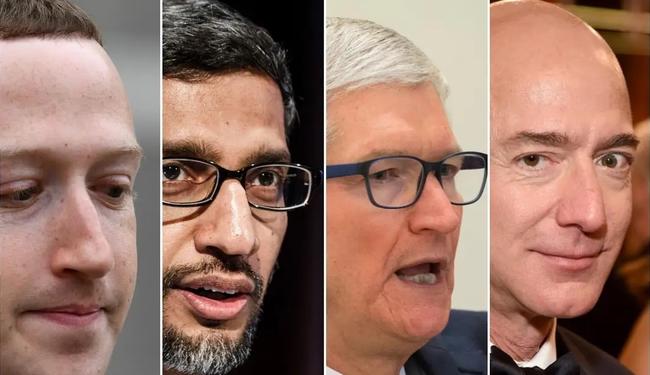
On Wednesday, the CEOs of Amazon, Google, Apple and Facebook will testify before House lawmakers over allegations of anticompetitive practices. For members of the House Judiciary antitrust subcommittee, it will be their sixth hearing in their investigation into Silicon Valley antitrust accusations. Composite photo via Business Insider
As Politico notes, "The session also arrives as scrutiny of the behemoths is surging across the globe, including an expected Justice Department antitrust case against Google and the recent launch of two European probes of potential anticompetitive behavior by Apple."
It will also mark the first time Jeff Bezos, the world's richest person, has offered testimony before Congress - albeit via videoconference, while House Judiciary lawmakers will attend both virtually and in-person in a hybrid format, according to the report.
That said, tomorrow's 'showdown' could go one of two ways; fireworks, or snoozefest. If House Democrats jump off script from antitrust issues and press the CEOs over online hate speech, or if GOP members drill them on anti-conservative bias, things could get interesting.
Even the format of the questioning — four elite CEOs, all appearing by videoconference because of the coronavirus pandemic — could make it harder for the members to land a glove on the companies’ varied issues, ranging from Google's and Facebook’s command of digital ad revenue to Apple's control of its App Store and questions about whether Amazon misled Congress. -Politico
"The discussion will go well beyond antitrust," said Carl Szabo, VP and General Counsel of NetChoice, a tech trade group which counts Google, Amazon and Facebook as members. "It will go into issues of election interference, or conservative bias, or any of the other issues de jour on which we like to saddle tech."
Here's what to expect assuming things go according to plan:
Lawmakers will likely question Bezos about whether an Amazon lawyer misled the Judiciary Committee last summer by claiming the company doesn't use data collected from third-party vendors to launch competing products of its own.
In fact, according to the Wall Street Journal, Amazon employees did just that - which prompted Judiciary leaders to question whether a criminal referral was appropriate for perjury charges. The company disputed WSJ's report, and said it did not 'intentionally mislead' the Committee - while also promising to conduct an internal investigation.
Facebook's Mark Zuckerberg will likely face questions over acquisitions of former rivals WhatsApp and Instagram, while Sen. Elizabeth Warren (D-MA) and others have called for regulators to break up the social media giant.
Other items of inquiry will include how Facebook handles its trove of data collected from more than 2 billion users, including whether it is for anticompetitive purposes.
"There's a real fear that no other competitor could ever successfully launch a social media platform because it could never match Facebook's troves of data, which, given their record, it's a serious threat to users," Rep. Joe Neguse (D-CO) told Politico.
Google's Sundar Pichai will have to answer for whether the company amplifies its own search services to the detriment of competitors and consumers seeking maps, videos or other services.
Separately, questions will be asked over whether their domination of online advertising has harmed smaller businesses as well as news outlets.
The committee has also accused the company of being less than forthright in its past testimony, including on questions such as what percentage of searches on the company's engine lead to website referrals not on Google.
Google has separately been a frequent target of Republican allegations of anti-conservative bias on its video sharing platform YouTube, a topic that is expected to come up again at Monday's hearing. Google and other major tech platforms deny those charges. Democrats, meanwhile, have taken issue with the company's handling of hate speech and misinformation on YouTube. -Politico
Lastly, Apple CEO Tim Cook will face questions over how the company has handled its app store.
"Because of the market power that Apple has, it is charging exorbitant rents — highway robbery, basically — bullying people to pay 30 percent or denying access to their market," Rep. David Cicilline (D-RI) told The Verge in June. "It’s crushing small developers who simply can’t survive with those kinds of payments. If there were real competition in this marketplace, this wouldn’t happen."
http://dlvr.it/RcXz8c
Tuesday, July 28, 2020
"Like Nothing We’ve Ever Seen": Imminent Eviction Wave Is Coming To These States
"Like Nothing We’ve Ever Seen": Imminent Eviction Wave Is Coming To These States Tyler Durden Tue, 07/28/2020 - 13:45
The eviction moratorium expired last Friday nearly four months after the US economy effectively shutdown due to the covid pandemic, and more than 12 million renters - all behind on rent payments because of the virus-induced recession - are now at imminent risk of getting booted to the curb.
This Friday, some 25 million Americans will no longer receive their weekly $600 federal unemployment checks, and the next round of government handouts, currently discussed by Republicans and Democrats, could see benefits slashed from $600 to $200 (or be nothing at all if no deal is reached in Congress). This would crush household finances across middle-class America, resulting in an even higher number of households unable to pay their rent bill in the months ahead.
That said, Trump's top economic advisor Larry Kudlow, who has religiously pumped stocks with meaningless headlines any time the S&P is even barely in the red, recently said an extension for the eviction moratorium program could be seen. But what if there isn't one?
In late July, more than 31 million Americans collected unemployment benefits of some form. The economic recovery reversed in late June, as the next crisis among households looms.
“It’s like nothing we’ve ever seen,” said John Pollock, coordinator of the National Coalition for a Civil Right to Counsel.
In 2016, there were 2.3 million evictions, Pollock said.
“There could be that many evictions in August,” he said.
On Sunday, food bank lines reemerged as people's benefits ran out. The number of jobless Americans is staggering and downright, depressionary, suggesting no labor market recovery this year or next.
With a fiscal cliff unfolding, benefits set to run out, and a rebound in the economy reversing, Household Pulse Data from mid-July outlines an even gloomier rent crisis unfolding.
The analysis is based on Household Pulse Data from mid-July and it found that some states will be hit harder than others. For example, West Virginia is estimated to have the highest share of renter households facing eviction at close to 60%. Tennessee, Minnesota, Mississippi, Florida and Louisiana are all among the states set to be worst impacted with shares at 50% or higher. Elsewhere, Vermont is the state where renters will be at the lowest risk of eviction, though 22% of them will potentially lose their homes over the course of the crisis. - Forbes
Shown below (charted by Statista), here are the states where renters will be pressured the most.
The Trump administration doesn't have the tools to solve the crisis - fiscal and monetary policy can only delay round two of the economic crash until after the elections. Meanwhile chaos and disagreement on Capitol Hill means that there is still no deal on a rent moratorium extension, which means that the coming weeks could see the largest ever US rent crisis, one which would make 2008 look like child's play.
http://dlvr.it/RcXsxH
Blistering Demand For Record Big 7Y Treasury Auction
Blistering Demand For Record Big 7Y Treasury Auction Tyler Durden Tue, 07/28/2020 - 13:19
After two ugly auctions to start the abbreviated Treasury week on Monday (due to the FOMC on Thursday), moments ago the Treasury sold another record-sized batch of paper, this time in the form of $44 billion of 7 Year notes, and unlike yesterday's 2Y and 5Y sles, this one went without a glitch.
As has been the case recently, the auction priced at a record low yield of just 0.446%, which was not only well below last month's 0.511%, but also stopped through the 0.452% When Issued by 0.6bps.
The bid to cover was a slight drop from last month's 2.489 to 2.449, which was below the 2.54 six-auction average, but the internals were solid, with Indirects taking down 63.9%, the highest since April and above the 62.7% recent average, while Directs took down 16.8%, above the 13.3% average leaving Dealers with 19.3% of the take down.
Overall, another stellar auction at the belly of the curve, which comes just before the FOMC, suggesting that any fears prompted by yesterday's ugly auctions were session specific and nothing has fundamentally changed with investor demand for US debt... of which a record amount will be sold in the coming years.
http://dlvr.it/RcXnh3
"Lies Spread Faster Than The Truth On Social Media" - Gates Slams COVID-19 Vaccine "Conspiracy Theories"
"Lies Spread Faster Than The Truth On Social Media" - Gates Slams COVID-19 Vaccine "Conspiracy Theories" Tyler Durden Tue, 07/28/2020 - 12:28
Bill Gates insisted last week that 'conspiracy theories' involving the Gates Foundation and the Microsoft founder's alleged hidden agenda to use vaccines as a cover for his nefarious micro-chipping project were utter nonsense. Apparently, Gates failed to grasp that this is exactly the kind of denial that a villainous billionaire might give.
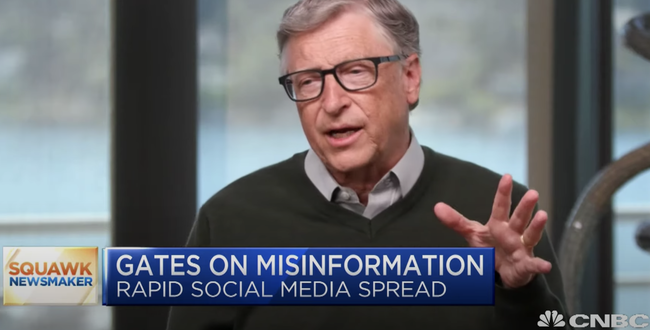
Whether or not you take the Gates-related 'conspiracy theories' seriously, the Microsoft founder clearly sees them as enough of an annoyance that he felt compelled to address the trend again during a Tuesday morning appearance on CNBC.
Responding to a question from interviewer Andrew Ross Sorkin about social media's role in spreading the conspiracies, Gates on Wednesday denied conspiracy theories that accuse the tech mogul and philanthropist of wanting to use coronavirus vaccines to implant tracking devices in people, and also said he hoped that the public's understanding of "the truth" would improve as the world gets closer to a vaccine.
"Very incorrect things that are very titillating...can spread much faster than the truth on social media, and we've always seen that with vaccines....social media can make that even worse...these social media companies can see what is being said on their platform and take things that are absolutely wrong and remove those things from the platform."
"How you divide that up, and draw that line...these are complex issues. It has been a spreader of lot of things...and how do you strike a balance?"
Would Gates take a harder line, the Sork asked, citing Mark Zuckerberg's commitment to be "all over" this type of misinformation.
Gates responded that Facebook can't intervene on Whatsapp since communications between users are encrypted. "Is that appropriate?" Gates said, expressing some skepticism about the risk of fostering criminal activity, though he said he doubted it would come up in tomorrow's hearing.
Asked to weigh in on the anti-trust push targeting Silicon Valley, Gates offered a mealymouthed response that was tantamount to a soft-endorsement of the status quo as far as 'Big Tech' is concerned.
"I do think people underestimate that natural competitive forces do come into this space...as mobile phones came in that was very competitive...even without massive regulation, there will be a lot of innovation," Gates said.
Is that really a surprise? After all, Gates and his wife may have donated nearly $2 billion to the vaccine research cause over the past few months. Gates insists that all he wants is to help defeat the coronavirus, and that may be true. But intelligent, capable people can still fall victim to their own biases. And whether a vaccine will ultimately bring about the end of the global pandemic still remains to be seen.
In February, the Bill and Melinda Gates Foundation said it was donating $100 million to vaccine research and treatment efforts for the coronavirus. It was announced as part of the WHO’s request for $675 million in contributions to fight the spread of the virus. In June, the foundation pledged an additional $1.6 billion to the Gavi vaccine alliance, an organization focused on efforts to immunize children amid the coronavirus pandemic.
But whatever Gates hoped to accomplish with these responses, adding his voice to the growing chorus of people calling for expanded censorship on social media certainly isn't going to help dissuade his critics.
If anything, that just leads to unnecessary controversies like this:
http://dlvr.it/RcXdns
Monday, July 27, 2020
NJ Gym Owners Accuse Gov Of "Flexing His Little Tyrant Muscles" After Being Arrested For Contempt
NJ Gym Owners Accuse Gov Of "Flexing His Little Tyrant Muscles" After Being Arrested For Contempt Tyler Durden Mon, 07/27/2020 - 14:40
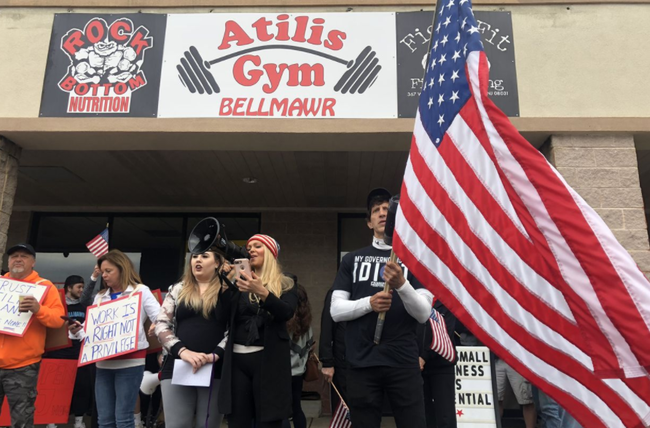
The owners of Atilis Gym, a gym in Bellmawr, NJ that was ordered by a New Jersey judge to close immediately, have been arrested on charges of contempt of court after refusing to comply.
Since it first defied the state and decided to reopen 2 months ago, the gym has become a local fixation, attracting protesters sympathetic with its cause. The report below, published earlier today, includes footage from some rallies that have been held at the gym.
Gym owners Ian Smith, 33, of Delanco Township, and Frank Trumbetti, 51, of Williamstown were charged with contempt of court, along with violating a disaster control act, according to the Camden County Prosecutor’s Office.
The owners of Atilis Gym in Bellmawr were arrested and released early Monday morning after continuing to operate their business despite a judge issuing a contempt order against them on Friday, according to Acting Camden County Prosecutor Jill S. Mayer.
Ian Smith, 33, of Delanco Township, and Frank Trumbetti, 51, of Williamstown, are charged with one count of fourth-degree Contempt, one count of Obstruction, and one count of Violation of a Disaster Control Act, both disorderly persons summons.
On July 24, the Honorable Judge Robert T. Lougy, issued a court order for Trumbetti and Smith to vacate the gym and cease operations.
From July 24 through July 27, a number of individuals were observed entered and using the gym, a direct violation of the court order.
Trumbetti and Smith were transported to the Bellmawr Police Department where they were charged and released.
All persons charged with crimes are presumed innocent until proven guilty in a court of law.
The gym owners have become a cause celebre in the movement to oppose lockdowns.
In other local news, dozens of New Jersey lifeguards have now tested positive for COVID-19, as public health officials worry about an outbreak focused around some of the state's beaches. Inspired in part by this string of infections, states from Connecticut to Rhode Island have ordered beaches to close to out-of-state residents, according to ABC News.
More than two dozen lifeguards from two New Jersey beach towns have tested positive for the coronavirus after having been together socially, authorities said.
Officials said the lifeguards are from Harvey Cedars and Surf City, neighboring boroughs on Long Beach Island.
Mayor Jonathan Oldham of Harvey Cedars said island health officials alerted the borough to the cluster Thursday and the lifeguards were being quarantined until they are cleared by doctors. Long Beach Island's health director said the guards were apparently together at two "social gatherings" earlier this month.
Harvey Cedars said Saturday that 17 lifeguards, all of whom had "attended a party in Surf City," had tested positive for COVID-19. The island's health director earlier said a dozen Surf City lifeguards had tested positive.
Harvey Cedars said on its website that it has 73 lifeguards and therefore "our beaches will remain fully staffed with all safety protocols in place.'' Surf City said its beaches "will remain protected from 10 a.m. to 5 p.m. daily" but "adjustments may be made from day to day to ensure the safety of all patrons and guards."
New Jersey officials earlier announced more than 500 new positive COVID-19 cases and an additional 11 deaths confirmed as associated with the virus, bringing the total number of deaths associated with the virus in the state to 13,867.
In a post on the gym’s Facebook page published Monday morning, Smith attacked NJ Gov Phil Murphy for “flexing his little tyrant muscles."
Despite the life guard infections, Murphy has continued to allow all protest-related activities to continue without any restrictions, even joining the marchers in person on occasion.
Maybe they can hook the governor up with a membership when all this is said and done?
http://dlvr.it/RcTDzv
Kyle Bass Slams TikTok As 'CCP Trojan Horse' Following Disturbing ProtonMail Exposé
Kyle Bass Slams TikTok As 'CCP Trojan Horse' Following Disturbing ProtonMail Exposé Tyler Durden Mon, 07/27/2020 - 14:20
Before using Chinese video-sharing app TikTok, one might want to read this article from encrypted email company ProtonMail, as recommended by Kyle Bass:
TikTok IS the Communist Party of China's Trojan Horse. Please read this piece...they are logging everything you do once you download the app. #tiktok #china #spies #Erased #DeleteTikTok https://t.co/5N7ZNChcOR — 🇺🇸Kyle Bass🇺🇸 (@Jkylebass) July 27, 2020
* * *
Authored by Richie Koch via ProtonMail
TikTok and the privacy perils of China’s first international social media platform
TikTok, the video-sharing platform owned by the Chinese social media giant ByteDance, is one of the most popular social media services in the world, with an estimated 800 million users. However, its zealous data collection, use of Chinese infrastructure, and its parent company’s close ties to the Chinese Communist Party make it a perfect tool for massive surveillance and data collection by the Chinese government.
After reviewing TikTok’s data collection policies, lawsuits, cybersecurity white papers, past security vulnerabilities, and its privacy policy, we find TikTok to be a grave privacy threat that likely shares data with the Chinese government. We recommend everyone approach TikTok with great caution, especially if your threat model includes the questionable use of your personal data or Chinese government surveillance.
How much user data does TikTok collect?
As with just about every social media platform, the answer is: “a lot.” According to its privacy policy, even if you just download and open the app but never create an account, TikTok will collect your:
* IP address
* Browsing history (i.e., the content you viewed on TikTok)
* Mobile carrier
* Location data if you are using a mobile device (including GPS coordinates and WiFi and mobile cell data)
* Info on the device you used to access TikTok (for Android devices, this includes your IMEI number, which is essentially your device’s fingerprint so it can be identified, and potentially your IMSI number, which is used to track users from one phone to another)
To open an account, you must enter a phone number or email and your date of birth. Once you have created an account, TikTok asks your permission for access to your social media accounts (like Twitter, Instagram, Facebook, etc.), your phone’s contact list, and GPS data.
Once you start using the app, TikTok logs details about:
* Every video you upload
* How long you watch videos
* Which videos you like
* Which videos you share
* Any messages you exchange in the app
Finally, if you buy coins, the in-app currency you can use to support your favorite video creators, TikTok will store your payment information.
According to TikTok, if you delete your account, the company will delete your account data, videos, and information within 30 days. This claim is impossible to independently verify, as is the case with most social media companies.
TikTok’s data collection is extreme, even for a social media platform that collects its users’ data to serve them with targeted ads. And TikTok explicitly states in its privacy policy that it shares your browsing data and email address with third parties so that it can serve you with targeted advertising.
TikTok faces multiple class-action lawsuits in the US
On November 27, 2019, a group of TikTok users in California filed a class action lawsuit against TikTok and ByteDance, saying the TikTok app “includes Chinese surveillance software.” The lawsuit claims TikTok collects all videos shot on the app, even if the videos are not published or even saved. The lawsuit goes on to allege that TikTok uses the videos and photos users upload to collect biometric data (such as face scans) without user permission and that even after you close the app, TikTok continues to collect biometric data.
This lawsuit also alleges that TikTok surreptitiously sends user data to China, something we will address below.
There is a similar class action lawsuit from users in Illinois. This suit also alleges that TikTok uses facial recognition technology and AI to collect users’ facial geometry without informing their users. Illinois has a strict law that requires companies to receive consent before they collect any biometric data.
Does TikTok share data with the Chinese government?
What distinguishes TikTok from other social media giants is that it is owned and operated by a Chinese company. ByteDance, the company that owns TikTok, is headquartered in Beijing and is worth over $100 billion. Chinese domestic laws and regulations, along with internal party politics, can make it hard to parse whether a company is independent or coordinating with the Chinese Communist Party.
Even if ByteDance wanted to resist Chinese Communist Party control, it would have little real prospect of doing so. China’s National Intelligence Law, passed in 2017, allows the government to compel any Chinese company to provide practically any information it requests, including data on foreign citizens. Furthermore, Chinese laws also can force these requests to be kept secret and not disclosed via transparency reports. The lack of an independent judiciary system makes it almost impossible for a company to appeal a request from the Chinese government. On top of that, Chinese companies of any real size are legally required to have Communist Party “cells” inside them to ensure adherence to the party line.
However, there is little evidence ByteDance wants to resist the Chinese government. In fact, there are numerous examples that it is complicit in the Chinese Communist Party’s authoritarian policies. In 2018, ByteDance shut down Neihan Duanzi, a Chinese social media platform that was primarily used to share jokes and comedy, after state censors accused it of hosting “vulgar” content. Afterward, ByteDance said that it would “deepen cooperation” with the Chinese communist party. It then hired 2,000 more “content reviewers” and stated that “strong political sensitivity” would be an asset for the position.
ByteDance has repeatedly made the case that TikTok is not available in China and that user data is not stored in China. This is misleading. In its privacy policy, TikTok explicitly reserves the right to share user information with other members of its “corporate group” (i.e., ByteDance).
Additionally, a white paper by the cybersecurity firm Penetrum found that over one-third of the IP addresses the TikTok APK connects to are based in China. The majority of these IP addresses are hosted by Alibaba, another Chinese tech giant. These IP addresses are what led to the allegations in the California lawsuit that TikTok secretly sends data to China. According to the Penetrum report, “TikTok does an excessive amount of tracking on its users and that the data collected is partially if not fully stored on Chinese servers with the ISP Alibaba.”
Alibaba works closely with the Chinese Communist Party and supports its invasive surveillance and censorship. It has a police post at its headquarters to facilitate data sharing with authorities and developed a popular Chinese propaganda app.
The Chinese government has long used the data it collects from Chinese tech companies to monitor, censor, and control its citizens. The all-seeing surveillance system they have created to monitor Uyghurs in Xinjiang is just one example. It also maintains an Orwellian “blacklist” that the government uses to prevent over 13 million “untrustworthy” citizens from purchasing plane or train tickets. One can only imagine what the Chinese government would do if it were able to extend its data collection beyond its borders.
TikTok and censorship
There are also concerns that the Chinese government and ByteDance are using TikTok as a tool to extend China’s censorship. American employees reported to the Washington Post that they were pressured by administrators in Beijing to restrict any political content.
New: Former TikTok employees told us the company's Beijing-based leadership often overrode their censorship concerns and restricted lots of social and political videos. "They want to be a global company ... but the decisions all come from China" https://t.co/AlUiibLPb8 @TonyRomm — Drew Harwell (@drewharwell) November 5, 2019
The Guardian reported on TikTok guidelines that require moderators to block videos that “distort” historic events, such as “Tiananmen Square incidents.” In one example, a teenage girl from Florida had her account shut down after she brought attention to the plight of the Uyghurs, a Muslim minority in China. (TikTok later reinstated her, claiming her ban was an error.)
Is TikTok secure?
In December 2019, the cybersecurity researchers at Check Point Research discovered multiple vulnerabilities, including ones that would allow attackers to delete user videos, make hidden videos public, or upload unauthorized videos. The researchers worked with the TikTok team, and they say that these vulnerabilities have now been resolved.
In April 2020, security researchers discovered that some versions of the TikTok app for Android and iOS rely on HTTP connections. By not using HTTPS, TikTok makes it easy for attackers to monitor user activity and even alter the videos the user sees without their knowledge.
TikTok says a fix is already underway, but this certainly isn’t a strong track record when it comes to security.
TikTok and children
Given the demographics of TikTok users and the amount of data TikTok collects, the company has faced criticism for collecting data from children. In February 2019, Musical.ly, the Chinese social media app that ByteDance bought and then merged with TikTok, paid a $5.7 million fine to the FTC to settle allegations that it violated the Children’s Online Privacy Protection Act (COPPA) by letting children under 13 sign up to its platform without their parents’ consent.
In May 2020, 20 advocacy groups alleged that TikTok is still violating COPPA. They said the company never deleted the personal information it collected from children under 13 prior to the 2019 FTC settlement, is still not obtaining parents’ consent before collecting children’s personal info, and does not allow parents to review or delete the personal information it collects from their children.
Scrutiny of TikTok increases
Since February, politicians in Australia have been calling for greater scrutiny of the company’s data collection and possible censorship. On June 29, the Indian government banned TikTok, along with over 50 other Chinese apps. And now, the US government is also weighing whether they should impose a ban on the app.
As one US lawmaker said to the Wall Street Journal, “all it takes is one knock on the door of their parent company [ByteDance], based in China, from a Communist Party official for that data to be transferred [from TikTok] to the Chinese government’s hands, whenever they need it.”
Recently, US politicians have floated the idea of ByteDance selling TikTok as one way for the social media company to avoid questions over what it does with its users’ data. However, Chinese infrastructure and control are clearly deeply integrated into TikTok’s system, and it would be extremely hard for any company that purchased it to undo.
Our take on TikTok
We stand for freedom of expression, and we want everyone to be able to voice their opinion. However, social media giants from TikTok to Facebook demand troves of personal data in exchange for the use of their platform. Often this data collection verges into the extreme. Does TikTok need access to your device’s ID number to deliver its service?
The fact that TikTok is owned by a Chinese company, one that has explicitly said it would deepen its cooperation with the Chinese Communist Party, makes this excessive data collection even more concerning. The Chinese government has a history of strong-arming and co-opting Chinese tech companies into sharing their data and then using this data to intimidate, threaten, censor, or engage in human rights abuses.
For these reasons, it is our opinion that, from a security and privacy standpoint, TikTok is an extremely dangerous social media platform. Its potential for mass collection of data from hundreds of millions of adults, teenagers, and children poses a grave risk to privacy. We believe that TikTok should be viewed with great caution, and if this concerns you, you should strongly consider deleting TikTok and its associated data.
You can get a free secure email account from ProtonMail here.
We also provide a free VPN service to protect your privacy.
ProtonMail and ProtonVPN are funded by community contributions. If you would like to support our development efforts, you can upgrade to a paid plan. Thank you for your support.
http://dlvr.it/RcT9gr
Platts: 5 Commodity Charts To Watch This Week
Platts: 5 Commodity Charts To Watch This Week Tyler Durden Mon, 07/27/2020 - 13:45
Via S&P Global Platts Insight blog,
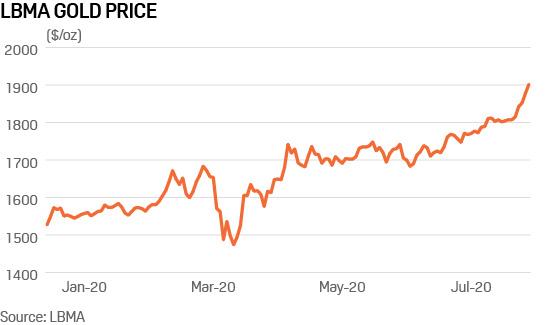
The relentless rise of gold prices is in focus this week in S&P Global Platts editors’ roundup of energy and raw materials trends. Plus, freight rates react to Brent’s slight recovery, coal generation in Germany fizzles out, and more.
1. Gold keeps smashing records on COVID fears, global debt
What’s happening? Gold pushed higher July 27 early in the European trading day, and took down the previous all-time high of $1,921/oz. Safe-haven buying has continued to spur the metal higher, boosted by a weaker US dollar, continued uncertainty regarding the US’s response to COVID-19, the probability of another multi-trillion US economic stimulus package, and the colossal global debt stimulated by central banks and governments worldwide.
What’s next? With the above factors likely now to be priced in, momentum may decrease with the yellow metal susceptible to short-term pullbacks. However, with rising inflation expectations as well as unprecedented fiscal stimuli and increasing government debt, many investment banking and financial services have increased their gold price forecasts for Q4 2020 as well as 2021. The elusive $2,000/oz mark may potentially materialise sooner than later.
2. Freight rates start to slump as oil rebounds
What’s happening? Tanker freight rates nosedived after experiencing a floating storage bonanza in April which saw rates for VLCCs on a WAF-East voyage near record-highs of over $70/mt in early April. A pick up in crude demand has seen Dated Brent prices recover from the April lows, but on the sea, this has served to worsen floating storage economics.
What’s next? According to S&P Global Platts Analytics, freight rates on the dirty tankers market will likely remain under pressure until OPEC+ cuts are reversed. OPEC and its allies aim to ease its 9.7 million b/d production cut to 7.7 million b/d in August, but even then, it remains to be seen how the improved production profile translates into seaborne exports.
3. China fuel inventory mounts after floods hit domestic demand
What’s happening? Since June, 23 provinces in China and Chongqing municipality have been suffering from heavy rains and floods. As a result, the regions’ transportation, construction and broader industrial activities came to a grinding halt, putting the brakes on domestic fuel demand recovery. Despite the setback, Chinese refineries have been maintaining high run rates in order to digest record-high crude imports, prompting oil product inventory to surge.
What next? The glut of fuel inventory has put a lot of pressure on China’s major exporters to actively seek overseas outlets to clear their excess supplies at home. China is expected to export 1.3 million-1.5 million mt of gasoline in August, while gasoil exports could possibly hit 2 million mt. In comparison, China exported only 676,000 mt of gasoline and 1.45 million mt of gasoil in May, latest data from General Administration of Customs showed.
4. German coal-fired generation hits rock bottom
What happened: German year-ahead coal-fired generation margins hit record lows this month while comparable gas-fired margins edged up. Behind the reversal of fortunes is a 30% fall in year-ahead TTF gas prices in 12 months, while the price of front-year coal into Europe has only fallen 12%. European carbon prices, a key driver of coal burn, hit a 14-year high July 13, easing since but remaining historically high. The trend has prompted RWE and Uniper to return mothballed gas plants to service while Vattenfall has booked a $1 billion impairment on its Hamburg coal plant, commissioned in 2015.
What’s next: German coal plants face closure under the country’s exit law approved July 3. A first auction for closure compensation for 4 GW of hard coal capacity is expected this September, the process targeting older units no longer in the market. Further auctions in the coming years will reduce capacity from 20 GW to a maximum of 8 GW by 2030. German hard coal generation only accounted for 6% of the power mix in H1 with 2020 coal imports set to shrink by up to 40%.
5. Ukraine maintenance shift could boost summer gas storage
What’s happening? In June, Ukraine’s gas grid operator GTSOU blindsided European gas traders with an announcement that maintenance would take place on a pipeline bringing gas via Slovakia into Ukraine at the Budince interconnection point between August 11-October 1, spanning part of the traditional stock-building season. But GTSOU has now shortened the work period to September 1-21, meaning that gas traders who bought gas for August delivery in the hope of injecting it into Ukraine’s under-utilized gas storage facilities via Slovakia will now be able to do just that.
What’s next? The shortening of the maintenance period comes as Ukraine continues to market spare capacity in its storage sites. According to data from UkrTransGaz and S&P Global Platts Analytics, Ukraine held 21.3 Bcm in stock at the beginning of Week 30, up 42% from a year ago and already close to the record high stocks of 21.8 Bcm set in late October last year. Ukraine can hold close to 31 Bcm in stock, and with injections set to continue through August, gas reserves in the country are likely to be significantly higher than in previous years. Importantly, the storage sites are able to act as a European gas storage “overflow”, given that stocks in the EU are currently 84% full.
http://dlvr.it/RcT4ZV
Subscribe to:
Posts (Atom)